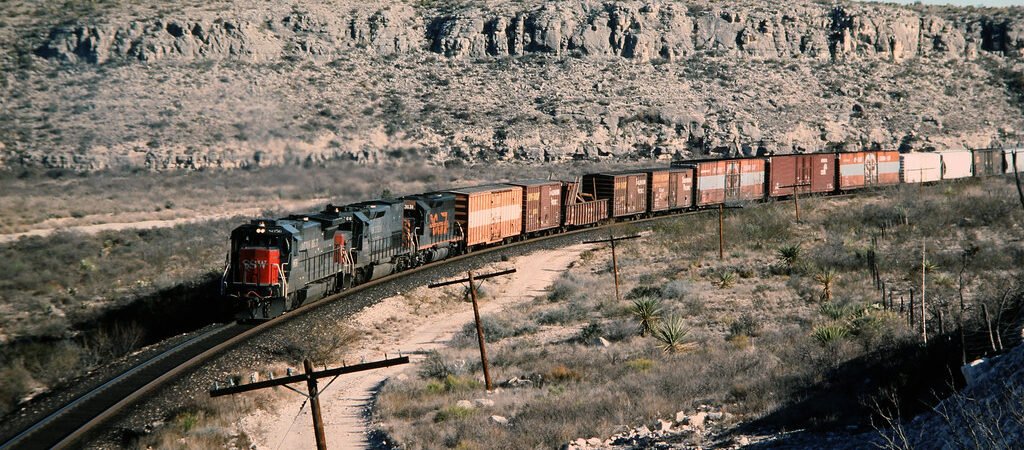
If you spend any time in Sanderson, Texas, you will hear two things. Trains in the distance and folks telling you this town would not exist without the railroad.
They are right. Without steel rail and a stubborn engineer’s name, Sanderson would still be a lonely stretch of caliche and creosote trying to mind its own business.
A division point in the middle of nowhere
Sanderson started as a railroad camp on the Galveston, Harrisburg and San Antonio line, the westward push that later became part of the Southern Pacific Railroad.
The railroad needed a division point between San Antonio and El Paso, a place to change crews, fuel up, and work on whatever had shaken itself loose. This one mile of flat ground in Sanderson Canyon fit the bill.
At first, the camp was called Strobridge, after James H. Strobridge, a railroad construction boss.
That name did not last. In 1882, when a roundhouse went in, the name was changed to Sanderson, after Thomas P. Sanderson, the engineer in charge of construction.
If you are searching “Sanderson Texas railroad history,” this is where it starts. Men, mules, steel, and a piece of West Texas that happened to be flat enough for the railroad to catch its breath.
Charley Wilson and the land deal
West Texas stories usually include at least one person who decides to out stubborn a big company. In Sanderson, that was Charley Wilson.
Wilson had been a soldier at Fort Concho. After he got out, he came here, helped protect the railroad survey party, and then quietly asked where the depot was going to sit.
Once he got his answer, he did the obvious thing. He rode to Austin and bought that exact piece of land before anyone else could.
When the railroad came back to build, he charged them for the privilege of putting their depot on his dirt.
That started a long feud between Charley and the railroad, but it also locked in where the depot would stand and helped fix this spot on the map as a permanent railroad town.
If you are looking up “Sanderson Texas train depot history,” you can start with the man who literally sold the railroad the ground under its own tracks.
The Sanderson train depot
The original Sanderson depot went up around 1882. It was a wooden clapboard building, built to a Southern Pacific “Common Standard No. 3” plan that the railroad used in many towns.
The pieces were prefabricated, shipped in, and assembled beside the tracks, which made sense in a place that did not have many lumberyards.
The depot sat low to the ground with a two story central tower that gave you a good view of the line.
Inside, there were waiting rooms, ticket space, and later a lunch room where passengers could grab a quick meal when trains stopped long enough for folks to stretch their legs.
In those early years, dining cars were not always part of the trip, so the Sanderson depot was both railroad station and local quick stop for a hot meal.
The building was handsome enough that people still share old photos and call it one of the better looking depots in this part of Texas.
If you searched “Sanderson Texas train depot,” that clapboard depot with the tower and bay windows is the one people remember.
A railroad town takes shape
Once the depot and roundhouse were in place, Sanderson filled with railroad men, ranchers, and people who were fine living somewhere that was also nowhere.
Southern Pacific built bunkhouses, shops, and other facilities to keep trains running, and the town grew up around that steady rhythm of wheels and whistles.
The railroad turned Sanderson into a division point, a place where crews changed, locomotives were serviced, and freight trains caught their second wind. That is the day to day story behind “railroad history Sanderson Texas.”
Local ranchers brought cattle and sheep into town to ship them out, turning Sanderson into an important livestock shipping center.
The depot also collected its share of stories. One of the more colorful ones is that it became the arrival point for two would be train robbers, one of them the last member of the Wild Bunch, hauled in after being caught.
Out here, even the outlaws eventually came through town like everyone else, by rail.
Lunch stops and long tracks
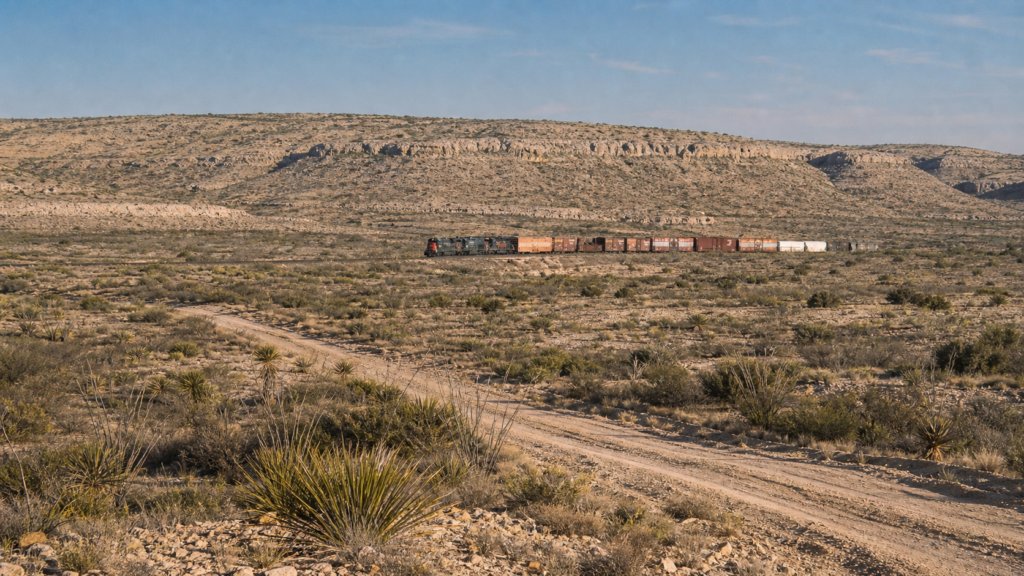
Passenger trains used to stop in Sanderson long enough for folks to hustle into the depot for a meal, then hurry back out before the conductor decided they had eaten plenty.
These days we mostly hear the long freight trains rolling through and the horns at night. The engineers ease up as they come past town, just enough respect for people trying to sleep in a place that already has plenty of noise from the wind and the coyotes.
The rail line itself is still active today. It now belongs to Union Pacific, and long freight trains continue to roll through town day and night.
If you stand near US 90 and hear that horn, you are listening to the same corridor that has carried freight and passengers through Sanderson for more than a century.
For anyone planning a Big Bend trip and searching “Sanderson Texas railroad town” or “railroad stop on US 90,” that sound is part of what you are coming to experience.
When the railroad pulled back
For about a hundred years, Sanderson was a terminal for Southern Pacific operations, with crews based here and the railroad anchoring the local economy.
That changed in the 1990s. After a serious head on collision near town and larger changes in the system, Southern Pacific moved the crew change terminal elsewhere in 1995.
When the terminal left, so did many railroad jobs, and Sanderson felt the loss the way any small town does when its main employer moves out.
The trains still came through, but fewer people worked them from here, and the depot began to sit empty.
If you are looking into “Sanderson Texas railroad history economic impact,” this is the turning point, when trains shifted from being the town’s main payroll to something you mostly heard more than you worked.
Losing the depot and keeping the line
After the crew terminal moved, the historic depot sat unused. It collected dust, broken windows, and plenty of opinions on what should happen next.
Local residents and preservation groups tried more than once to save it, and it was listed as a threatened resource by Preservation Texas.
The effort ran into short deadlines, a requirement from Union Pacific that the building be moved, and limited county support. In the end, the oldest structure in town came down.
The depot was demolished in October 2012, taking the tower and wooden walls with it, but the tracks and the stories stayed behind.
For anyone who searched “Sanderson Railroad Depot demolition” or “Sanderson Texas lost depot,” that is the story. A strong push to save it, and a final decision that did not go the way many hoped.
The Sanderson Amtrak station today
The site did not stay empty. In 2021, Amtrak and its partners opened a new shelter style Sanderson station at the old depot location, giving the town a modern, accessible stop again.
It is a simple, unstaffed structure along West Downie Street, with a platform, shelter, and walkways where you can wait out of the wind and sun for the train.
Sanderson is now one of the quietest Amtrak stops in the country, seeing only a few hundred passengers a year getting on or off, which fits our style just fine.
You are not fighting a crowd. You step down into a small West Texas railroad town, close to US 90, with a big sky and long freight trains still rushing past after the passenger train is gone.
If you searched “Sanderson Amtrak station” or “Amtrak Sanderson TX SND,” this is what you will find. A quiet stop, a long railroad history, and a town that still lives with the tracks right next door.
Railroad heritage in the Cactus Capital
Today, Sanderson is known as the Cactus Capital of Texas and as the county seat of Terrell County.
We sit on US 90 between canyons, with a mix of ranching, rail, road trippers, and people who like wide horizons more than big crowds.
We have traded roundhouse jobs for motels, a visitor center, and travel traffic, but the railroad line still cuts straight through town, just like it always has.
You can still see the railroad’s mark in the way the streets hug the tracks, in the stories folks tell about the old depot, and in the Amtrak stop that keeps us on the national passenger map.
If you are searching for “Sanderson Texas railroad heritage,” “Sanderson TX train depot history,” or “West Texas railroad towns,” you are the kind of visitor this place was built on.
Pull in off US 90, or step off the train at Sanderson station, and you will be standing in a town that owes its existence to the rails, even if the depot is gone and the humor is a little drier than the climate.
Most nights you will hear a horn somewhere out in the dark, not as loud as it could be, just a reminder that the line is still alive and the trains are still looking out for the people who live here.
Sanderson, Texas History
Sanderson, Texas History: Wool, Mohair, and the Rise of a West Texas Town
Sanderson Train Robbery: The Wild West Shootout at Baxter’s Curve