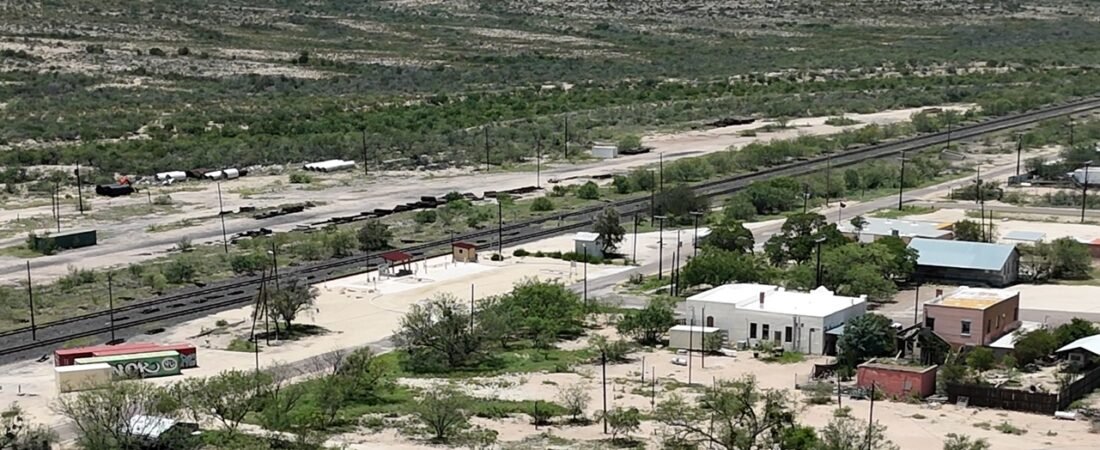
On a dark March night in 1912, two outlaws thought they had found the perfect place to rob a train. Instead, near Sanderson, Texas, they found the end of the Old West.
There are places in West Texas where the land seems to remember.
The country around Sanderson is wide, dry, and unforgiving. The hills rise in the distance, the railroad runs through long stretches of open land, and the night can feel big enough to swallow a man whole. More than a century ago, that isolation looked like opportunity to two desperate outlaws.
One was Ben Kilpatrick, called the “Tall Texan,” a former member of Butch Cassidy’s Wild Bunch. The other was Ole Hobek, his lesser-known partner. Together, they believed a train passing through the lonely country between Dryden and Sanderson would make them rich.
They were wrong.
What became known as the Sanderson train robbery—officially remembered as the Baxter’s Curve Train Robbery—did not end with a getaway across the desert. It ended in violence inside a railroad express car, with an ice mallet, a rifle, and two dead train robbers brought into Sanderson before dawn. The Texas Historical Commission recognizes the event as one of the last major train robberies in West Texas.
Sanderson Train Robbery at a Glance
- Also known as: The Baxter’s Curve Train Robbery
- Date: March 13, 1912
- Location: The railroad line between Dryden and Sanderson, Texas
- Outlaws: Ben Kilpatrick and Ole Hobek
- Railroad: Galveston, Harrisburg and San Antonio Railway Train No. 9
- Man who stopped the robbery: Wells Fargo express messenger David A. Trousdale
- Why it matters: One of the last major train robberies in West Texas
What Was the Sanderson Train Robbery?
The Sanderson train robbery was an attempted holdup in the early hours of March 13, 1912, on the Galveston, Harrisburg and San Antonio Railway line between Dryden and Sanderson, Texas.
Ben Kilpatrick and Ole Hobek boarded the westbound train when it stopped at Dryden, took control of the crew, and ordered the train toward Baxter’s Curve. There, away from help and hidden by the West Texas night, they planned to search the baggage and express cars for valuables.
Their target was more than the passengers. The express car held the kind of freight that had long drawn train robbers: mail, commercial shipments, money, and goods moving between distant cities. For Kilpatrick and Hobek, it looked like a final chance at a big score.
For Wells Fargo messenger David A. Trousdale, it was his responsibility.
Before sunrise, he would make certain the two outlaws never escaped with it.
A Remote Curve in West Texas
To understand why the robbers chose this country, one must picture West Texas as it was in 1912.
The railroad was lifeblood. It carried people, mail, money, equipment, supplies, and news through country where small towns were separated by long miles of hard land. But every stop for water, curve in the tracks, bridge crossing, and mechanical delay also created a moment of vulnerability.
A lonely stretch of rail could look like an invitation to a robber.
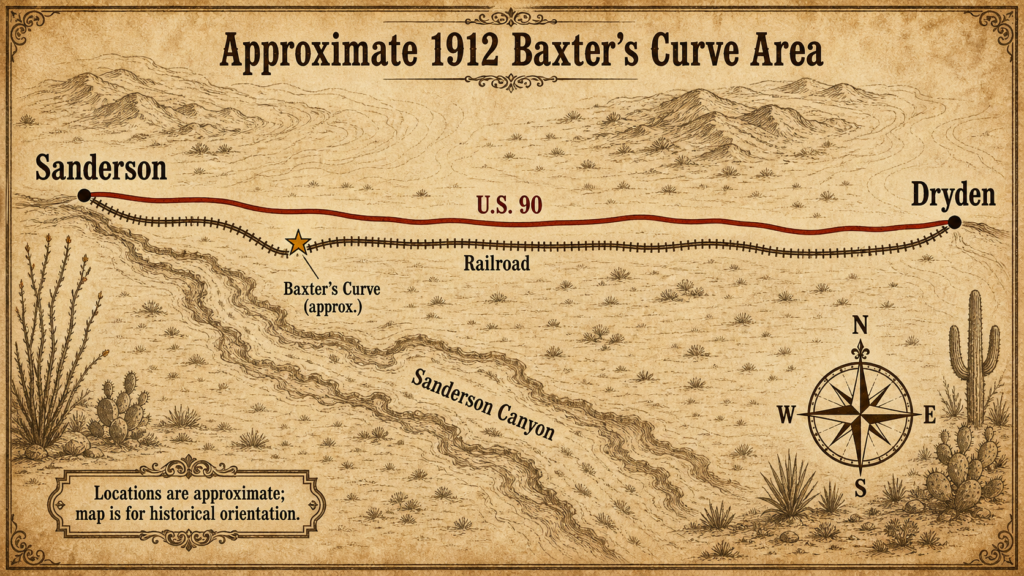
Kilpatrick and Hobek chose the general Baxter’s Curve area between Dryden and Sanderson because it offered what they wanted: darkness, distance, and time. Their plan was to separate the train, rob the valuable forward cars, and escape before anyone could organize a response.
It was not a foolish plan on paper.
But railroads were filled with working men who knew the risks of the job, and not all of them were willing to surrender when a gun was pointed their way.
Ben Kilpatrick, the “Tall Texan”
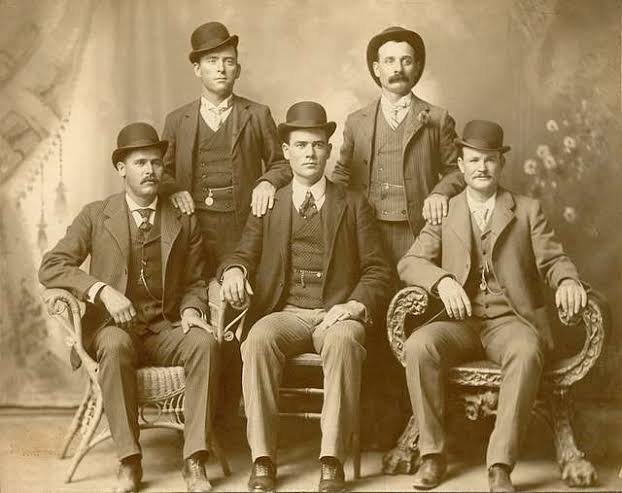
Ben Kilpatrick was not a greenhorn chasing a quick score.
Born in Texas, he became one of the best-known members of the Wild Bunch, the outlaw band associated with Butch Cassidy and the Sundance Kid. Kilpatrick had already lived through the hard and violent world that later became Old West legend. He had robbed trains, faced the law, served time in prison, and been released in 1911—only a short time before the events at Baxter’s Curve.
Photographs show the figure people expect from an outlaw of that era: tall, stern, armed, and self-assured. Yet the romance of the Old West leaves out the fear that train robbery brought to passengers, railroad crews, and the small communities tied together by the rails.
By 1912, the age of open-range train robbery was fading. Railroads were becoming more organized. Law enforcement was improving. The outlaw days were slipping from reality into legend.
Kilpatrick may have believed he was stepping back into that legend.
Instead, he stepped into the last night of his life.
Ole Hobek: The Man at Kilpatrick’s Side
Ole Hobek never became as famous as Ben Kilpatrick, though history placed him beside the Tall Texan in Sanderson’s best-known outlaw story.
Compared with Kilpatrick, Hobek left behind fewer photographs and fewer clear accounts. Later retellings say the two men formed their partnership after meeting in prison. Whatever brought them together, Hobek was no bystander at Baxter’s Curve. He was armed, involved in taking control of the train, and committed to the escape plan.
History often remembers one man by name and leaves the other as “the accomplice.” But Hobek made the same choice Kilpatrick did. He climbed aboard that train, entered the darkness of the West Texas rail line, and did not come back out alive.
The Train Stops at Dryden
Dryden was no place for a man to expect quick help in 1912. A train stop there meant water, coal smoke, the hiss of steam, and a brief patch of lamplight against a country otherwise given over to dark hills and open distance.
Train No. 9 had come west from Del Rio, carrying passengers toward El Paso through the rough, thinly settled country of the borderlands. Near midnight, it stopped at Dryden to take on water.
That was when the two men came out of the dark.
They did not arrive as legends. Not at first. They arrived as armed robbers, and the men on the train had to decide, in a matter of moments, whether they were dealing with a bluff, a robbery, or a killing.
Kilpatrick and Hobek took control of the crew. Then they ordered the train forward toward an iron bridge and had the passenger coaches separated from the engine, tender, baggage car, and express car.
The passengers were left behind while the forward section moved farther into the darkness.
One can only imagine the feeling in those stranded coaches: the sudden stop, the separation of the cars, and the knowledge that somewhere ahead, beyond the reach of their voices, the robbery was unfolding.
Inside the Express Car
The express car contained the men who would decide the outcome of the Sanderson train robbery.
David A. Trousdale was a 32-year-old Wells Fargo express messenger. Also caught in the crisis were mail clerk M. E. Banks, a helper identified in historical accounts as Reagan, and railroad crew members forced to follow the robbers’ orders.
Trousdale was not a sheriff. He was not part of a posse. He was a working man placed in charge of the shipments and valuables under his care.
Kilpatrick and Hobek demanded access to the car’s contents. Trousdale understood that open defiance could get everyone killed. At first, he did what the robbers expected: he appeared cooperative.
He pointed out packages with little value. He gave the impression that he was frightened and manageable. And he waited.
There is an old lesson in that. A desperate man with a gun may think he controls a room. But he does not always see what the quiet man in the corner has noticed.
The People Caught in the Middle
It is easy, after more than a century, to tell this story as if it belonged only to famous outlaws and one brave express messenger. But the train carried more than a legend in the making.
There were railroad men at their posts, a mail clerk responsible for federal mail, passengers separated from the forward cars, and crew members held at gunpoint in a place where no town, sheriff, or doctor stood close at hand.
Kilpatrick and Hobek chose Baxter’s Curve because it was remote. That same remoteness made everyone aboard vulnerable. A gunshot in the dark was not merely a dramatic turn in an outlaw story. It was a danger to ordinary people who had expected only to ride the rails across West Texas.
That is why David Trousdale’s response mattered. He was not merely protecting freight. He was helping end a crisis before it could grow worse.
The Ice Mallet
Trousdale did not know how much time he had.
The robbers had guns. They believed the train was theirs. Outside the car lay miles of West Texas darkness, and somewhere beyond the tracks waited the escape they had planned.
But a robbery can turn on the smallest thing: a loose board, a forgotten latch, a man who keeps his head—or, in this case, a wooden tool beside a shipment of iced oysters.
Near the oyster shipment was an ice mallet, sometimes called an ice maul in retellings of the event. Trousdale saw it and waited for the moment when Kilpatrick’s attention shifted.
In his later account, Trousdale described seizing the mallet when Kilpatrick bent down to examine a package. He struck the outlaw, stunning him and overturning the robbers’ control of the car.
The men inside moved quickly. They took weapons from Kilpatrick and armed themselves. The lights in the express car were extinguished. What had seemed like an easy robbery became a dark, confused standoff.
Hobek came toward the car, apparently unaware that the plan had already collapsed. He was shot when he appeared at the entrance. Kilpatrick, injured in Trousdale’s first attack, was also killed.
Thus ended the robbery.
No galloping escape. No hidden fortune. No outlaw victory.
Only darkness, gunfire, and two men who had mistaken a railroad car full of working men for easy prey.
Dynamite, Guns, and an Escape That Never Happened
The failed robbery was not a casual crime of opportunity.
Later accounts describe firearms and explosives among the equipment associated with the robbers, including dynamite and caps. Those details suggest Kilpatrick and Hobek were prepared to force open safes or destroy property if their demands were not met.
Other retellings say horses had been placed nearby for an escape and add the colorful claim that the horses’ shoes were reversed to confuse pursuers. Such details may be true, but they deserve cautious treatment unless confirmed by contemporary reporting or official records.
The central fact is clear enough: the robbers expected to leave Baxter’s Curve alive.
They did not.
The Train Reaches Sanderson
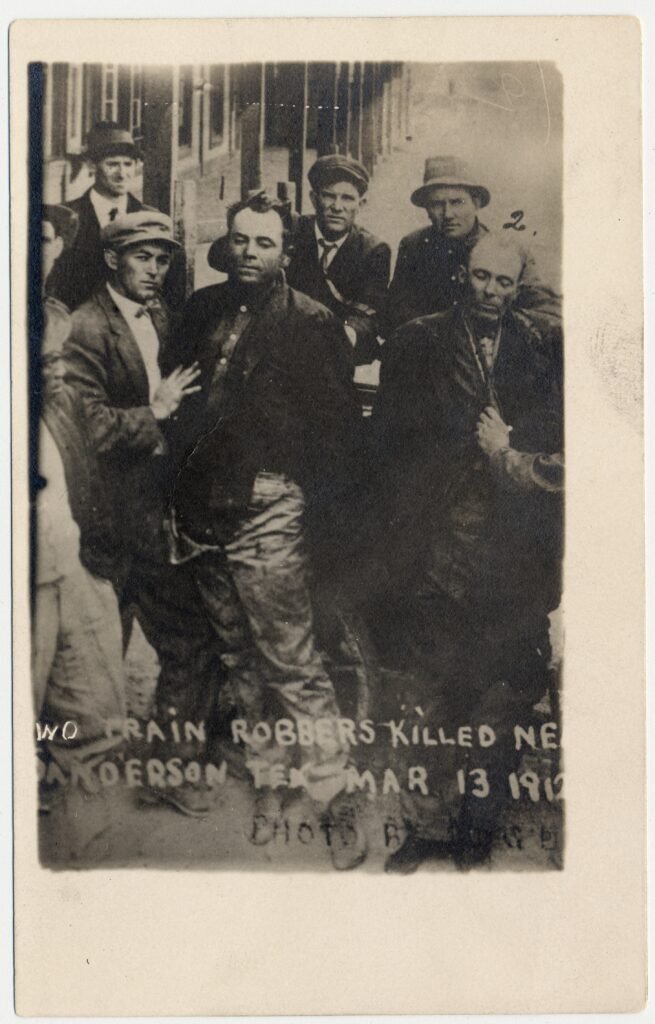
After the violence at Baxter’s Curve, the train had to be put back together. The engine returned, the passenger cars were reconnected, and the train continued toward Sanderson.
By the time it arrived, Kilpatrick and Hobek were dead.
Accounts place the train’s arrival in Sanderson at about 5 a.m. The bodies of the two robbers were removed, and a photograph was taken at the depot. To modern eyes, the public display of the dead can seem disturbing. But it reflects an earlier era, when scenes of crime, violence, and justice were often handled with a bluntness that feels unsettling now.
Sanderson did not choose to become the setting for a final Wild West train robbery. Yet by sunrise, this small West Texas town had become part of a story that would be told for generations.
Buried in Sanderson
Ben Kilpatrick and Ole Hobek were buried in Sanderson. Later accounts identify Cedar Grove Cemetery as their burial place.
Their graves have attracted historians, Western-outlaw enthusiasts, and travelers interested in the area’s past. But they should be approached with respect.
They are not movie props. They are graves.
Visitors interested in the Sanderson train robbery should verify local access conditions before visiting, remain on established paths, respect all gravesites, and avoid leaving objects or disturbing the cemetery in any way. The story belongs to local history, but the cemetery remains a place of rest.
Later accounts note that flooding and changing cemetery conditions have created uncertainty around the precise condition of the burial site over time. In a way, that uncertainty belongs to the story as well. West Texas preserves history, but it does not always preserve it neatly.
Was It Really One of the Last Texas Train Robberies?
The Sanderson train robbery is often described as one of the last great train robberies of the Old West.
That description is fair, but it needs care.
The strongest wording comes from the Texas Historical Commission, which calls the Baxter’s Curve incident one of the last major train robberies in West Texas. That is more accurate than declaring it the final train robbery in all of Texas.
Some historical accounts identify a later Newton Gang robbery near Uvalde in 1914 as the last train robbery in the state. However one defines “last,” the Baxter’s Curve story feels like an ending.
It held so many elements of the older West: an infamous outlaw, a midnight train, a desert escape plan, guns, explosives, and an isolated railroad line. Yet it also showed the change that was coming.
The outlaws did not win.
The men who kept the railroad moving did.
David A. Trousdale’s Quiet Courage
There are men whose names become famous because they seek fame. Then there are men remembered because they found themselves in a hard place and did what had to be done.
David A. Trousdale belongs to the second kind.
Historical accounts say he received public recognition and rewards for his actions from Wells Fargo, the federal government, the railroad, and passengers. The exact reward figures should be verified through primary documents before being stated as final fact, but the larger truth is not in doubt: his conduct was widely recognized.
He did not end the robbery with a badge or a posse. He ended it with composure, timing, and the willingness to act when the moment came.
That is why the Sanderson train robbery is not remembered only as Ben Kilpatrick’s final crime.
It is also remembered as David Trousdale’s night.
The Sanderson Train Robbery: Legend and Record
A story this dramatic gathers details as it passes from one generation to the next. Some are well supported. Others are vivid enough to survive even when the paper trail is thin.
The official record is clear on the essentials: Kilpatrick and Hobek boarded the train at Dryden, ordered it toward Baxter’s Curve, separated the cars, and attempted to search for valuables. Trousdale fought back with an ice mallet and a rifle, ending the robbery.
Other details—including the precise amount of money sought, the full inventory of explosives, getaway horses with reversed shoes, and the role of an alleged young helper—appear in later retellings. They add color to the tale, but should be presented as reported details rather than unquestioned fact unless contemporary records confirm them.
The true story needs no embellishment. Two seasoned outlaws selected a lonely stretch of West Texas railroad for a final score. A Wells Fargo messenger refused to yield. By morning, the train had reached Sanderson, and the Old West had lost two more of its hard men.
Why the Sanderson Train Robbery Still Matters
The story of Baxter’s Curve is more than an outlaw tale.
It is a story about West Texas when railroads connected distant towns and carried the lifeblood of commerce across difficult country. It is a story about the fading reality behind the Old West myth. And it is a story about Sanderson—a town whose history reaches beyond its size.
For visitors, the Sanderson train robbery adds another layer to the landscape. The road between Dryden and Sanderson is not simply a route through striking, empty country. The railroad nearby is not simply a line across the desert.
It is the setting of a final reckoning.
Kilpatrick and Hobek came to Baxter’s Curve looking for fortune. What they found was resistance. The train went on. Sanderson woke to a story. And the old West, in one small but violent moment, moved a little farther into history.
Sanderson Train Robbery Timeline
Sanderson Train Robbery Timeline
A reconstruction of the events surrounding the Baxter’s Curve Train Robbery near Sanderson, Texas.
| Date / Time | Event |
|---|---|
| Evening of March 12, 1912 | Train No. 9 departs Del Rio heading west toward El Paso. |
| Near midnight | The train stops at Dryden for water. |
| Early March 13, 1912 | Ben Kilpatrick and Ole Hobek board the train and seize control of its crew. |
| Shortly afterward | The passenger cars are separated from the engine, baggage car, and express car. |
| Early morning | The attempted robbery at Baxter’s Curve fails; Kilpatrick and Hobek are killed. |
| About 5 a.m. | The train arrives in Sanderson with the bodies of the two outlaws. |
| Afterward | Kilpatrick and Hobek are buried in Sanderson. |
Note: The timeline is based on surviving historical accounts and is an approximate reconstruction where exact times cannot be independently confirmed.
Visit the History of Baxter’s Curve
The Sanderson train robbery happened in an isolated stretch of railroad country, but its memory remains part of Terrell County.
Visitors can begin in Sanderson, learn about the area’s railroad and borderlands history, and look for the Texas Historical Commission marker commemorating the Baxter’s Curve Train Robbery near U.S. 90. Those visiting Cedar Grove Cemetery should do so respectfully. The graves connected to Kilpatrick and Hobek are part of Sanderson’s history, but the cemetery is first and foremost a place of rest.
A trip through this part of West Texas is a reminder that history is not always found behind glass. Sometimes it lies beside a highway, along a rail line, or beneath a desert sky where an old story refuses to disappear.
Frequently Asked Questions
What was the Sanderson train robbery?
The Sanderson train robbery was an attempted train holdup near Sanderson, Texas, on March 13, 1912. It is also called the Baxter’s Curve Train Robbery.
Who tried to rob the train?
Ben Kilpatrick, a former member of the Wild Bunch, and his partner Ole Hobek attempted the robbery.
Who stopped the Sanderson train robbery?
Wells Fargo express messenger David A. Trousdale stopped the robbery. Historical accounts say he used an ice mallet to strike Kilpatrick and then helped defend the express car against Hobek.
Where did the Baxter’s Curve Train Robbery happen?
It occurred on the railroad line between Dryden and Sanderson in Terrell County, West Texas.
Are Ben Kilpatrick and Ole Hobek buried in Sanderson?
Yes. The Texas Historical Commission states that Kilpatrick and Hobek were buried in Sanderson. Later accounts identify Cedar Grove Cemetery as their burial place.
Is there a historical marker for the Sanderson train robbery?
Yes. Texas Historical Commission Marker No. 16553 commemorates the Baxter’s Curve Train Robbery near Sanderson.
Historical Sources and Editorial Note
This article is based primarily on the Texas Historical Commission’s Baxter’s Curve Train Robbery marker record, along with historical accounts that preserve David A. Trousdale’s recollections of the attempted robbery.
Historical accounts do not agree on every detail. Where a detail comes from later retellings rather than the official marker record, this article identifies it as such. Before publishing final claims about money, rewards, explosive devices, horses, or grave conditions, confirm them through contemporary newspapers, railroad records, Wells Fargo archives, or Terrell County documentation.