By the SandersonTexas.org History Desk
This article was written by a woman raised in West Texas, drawing on local history, public records, and the practical knowledge passed down in rural communities.
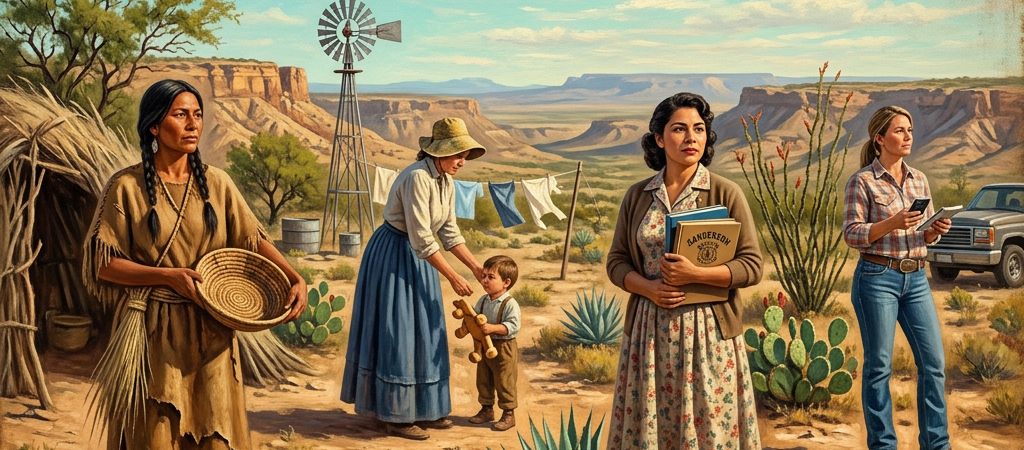
The history of Terrell County cannot be told only through railroads, ranches, cowboys, and courthouse politics. Women helped make daily life possible in this rugged, remote part of West Texas. They managed homes, raised children, stretched household budgets, cared for the sick, taught school, worked in stores, cooked for families and ranch hands, and held communities together through hard times.
Anyone raised in West Texas understands that distance changes the meaning of ordinary chores. A trip for groceries, school supplies, a doctor’s appointment, or a visit with relatives could require planning well before anyone got in the car. In earlier generations, the challenges were even greater. Heat, drought, limited water, long dirt roads, few nearby services, and unpredictable weather shaped nearly every part of family life.
For generations of women in Sanderson and across Terrell County, resilience was not an abstract idea. It was part of the daily routine.
Life for Women in Early Terrell County
Sanderson began as a railroad town in the early 1880s, and Terrell County was organized in 1905. The county’s economy grew around the Southern Pacific Railroad, cattle ranching, sheep, wool, mohair, and the businesses needed to serve ranch families, railroad workers, travelers, and local residents.
Women lived in town, on ranches, in railroad families, in Mexican American neighborhoods, and in homes spread across the wide open country surrounding Sanderson. Their lives were different in many ways, but nearly all faced the same realities of West Texas: distance, isolation, weather, limited resources, and the need to make do.
In the earliest years of Sanderson, even water could be a difficult task. Families had to obtain, carry, store, heat, and conserve it for drinking, cooking, washing clothes, bathing children, cleaning, and caring for animals. Before modern conveniences, a household required constant labor.
A person does not have to romanticize the past to understand its demands. A home in early Terrell County was not simply a place to rest at the end of the day. It was a kitchen, laundry room, nursery, sewing room, pantry, first-aid station, schoolroom, office, and gathering place. For many women, it was also a workplace.
Ranch Women in Terrell County
Ranching shaped Terrell County, and women were essential to ranch life. The history of West Texas is often told through ranch owners, cattle drives, sheep shearing, fence lines, stock tanks, and cowboys. But ranch households did not run on livestock alone.
Women planned meals, managed food supplies, preserved vegetables and meat when possible, washed clothes, mended work shirts, sewed clothing, cared for children, kept household accounts, and often helped with livestock and ranch duties. If hired hands, shearers, neighbors, or travelers were present, a woman might be expected to prepare meals for a larger group with little notice.
Many ranch women helped in ways that were rarely described as formal employment. They kept records, handled correspondence, paid bills, ordered supplies, cared for chickens and milk cows, tended gardens when water allowed, and stepped in during lambing, sickness, emergencies, or busy ranch seasons.
In this country, women’s work was often called “helping,” even when it meant holding together the entire practical life of a household and ranch.
A ranch woman might spend part of her day cooking breakfast before sunrise, getting children ready for school, washing clothes, keeping track of supplies, helping with animals, preparing supper, and making sure the next day was ready before she went to bed. That work did not always show up in land records, business directories, or newspaper headlines. Still, it was necessary work, and the ranch economy depended on it.
Women’s Jobs in Sanderson and Terrell County
Not every woman in Terrell County lived on a ranch. Sanderson’s railroad, courthouse, schools, stores, hotels, cafés, boardinghouses, and local businesses created opportunities for women to earn money and contribute to family income.
Women’s paid work in early and mid-century West Texas often included teaching, domestic work, laundry work, sewing, cooking, clerical work, retail sales, hospitality, childcare, and family businesses. In a small county seat such as Sanderson, women could be found in places where people needed food, lodging, clothes, supplies, education, care, and practical help.
Women’s work may have included:
- Teaching in local schools
- Working as school staff or office workers
- Keeping books for ranches, stores, or family businesses
- Working as store clerks or cashiers
- Sewing, mending, dressmaking, or laundry work
- Cooking in homes, cafés, boardinghouses, or for large gatherings
- Cleaning homes, businesses, hotels, or railroad-related lodging
- Providing childcare for relatives, neighbors, or working families
- Operating or assisting with boardinghouses, cafés, stores, or small local businesses
- Serving as nurses, caregivers, church workers, and community volunteers
Family businesses often depended on women’s labor whether or not their names appeared on the sign outside. A woman might keep the books, wait on customers, organize supplies, prepare meals, write letters, manage the household, and still be described only as someone’s wife, mother, or daughter.
That is one reason women’s history can be harder to find in official records. Their work was often treated as ordinary, expected, or invisible. But it was real work, and it made local businesses and families possible.
Raising Children in Remote West Texas
Childcare in historic Terrell County was usually a family and community responsibility. Mothers carried much of the daily work, but older sisters, grandmothers, aunts, neighbors, and older children often helped. In a small town or isolated ranch country, families depended on one another.
Raising children meant much more than watching over them. Women prepared meals, made and mended clothing, treated minor illnesses, taught manners and practical skills, managed household routines, and tried to make sure children attended school despite distance, weather, work demands, and transportation challenges.
For families living outside Sanderson, getting children to school could be a major task. Some rural children faced long bus rides over rough roads. Bad weather, vehicle trouble, illness, ranch work, and family needs could all affect whether a child made it to school on a given day.
West Texas mothers understood the importance of planning. Clothes had to be ready. Food had to be available. Transportation had to be arranged. Children had to be watched around animals, machinery, open country, and the everyday hazards of rural life.
A kitchen table could serve as an office, a classroom, a sewing room, a first-aid station, a place for bills and school papers, and the center of family decision-making. That was true across Texas, but especially in a remote county where help might be miles away.
Mexican American Women in Sanderson
The history of women in Terrell County must include Mexican American women and families, whose work, traditions, labor, and community ties were central to Sanderson and the surrounding ranch country.
Mexican American women contributed through paid work, family labor, childcare, cooking, cleaning, laundry, church life, and mutual support among relatives and neighbors. Their work helped sustain homes, ranches, businesses, and community life, even when public histories failed to record their names or experiences in detail.
Life in Sanderson was not equal for everyone. Like many Texas towns of the era, Sanderson experienced segregation in schools, housing, public places, and cemeteries. Mexican American families often faced fewer opportunities and greater hardships, yet they built strong family networks and community traditions.
Their stories deserve fuller attention in Terrell County history. Oral histories, family photographs, church records, school records, newspaper notices, and cemetery research can help recover the names and experiences of women who were too often left out of the official story.
A complete history of Sanderson cannot focus only on the people whose names appeared in government records, business advertisements, or newspaper headlines. It must also include the women who kept families going, raised children, worked long hours, and passed down traditions through generations.
Women, Schools, Churches, and Community Life
In a small community, women often helped build the social life that held people together. They organized school events, church meals, holiday programs, fundraisers, charity drives, family gatherings, and support for neighbors facing sickness, death, financial hardship, or disaster.
Women’s clubs, church groups, parent organizations, and informal networks gave women a way to improve their communities long before women had equal access to political and economic power. Through these organizations, women supported education, libraries, history preservation, family welfare, beautification projects, and civic improvement.
In Sanderson and Terrell County, community life depended on people who showed up. When someone was sick, neighbors brought food. When a family lost a loved one, women organized meals and support. When children needed school supplies, clothing, or help getting to an event, someone found a way.
Growing up in West Texas teaches a person that neighbors do not always wait to be asked. They bring food after a loss, check on the elderly, help gather children, and show up when a family is in trouble. That tradition has deep roots in communities such as Sanderson.
Women were often at the center of that tradition.
Women During Hard Times
Terrell County residents have always lived with uncertainty. Drought could hurt ranch income. A family illness could become serious when medical help was far away. Floods and severe weather could damage homes, roads, and businesses. Railroad employment, ranch markets, and local business conditions could change quickly.
During difficult times, women often became organizers, caregivers, cooks, record-keepers, and providers of emotional support. They helped children feel safe. They made meals from limited ingredients. They cared for relatives. They found ways to stretch money. They coordinated help through churches, neighbors, schools, and family networks.
The 1965 Sanderson flood remains one of the most important events in local history. It brought devastating loss to the community and required neighbors to help one another through an emergency few could have imagined. In a crisis, the work of women may not always have been formally recorded, but their contributions were part of the community’s survival and recovery.
Women cared for children, helped relatives, prepared food, opened homes, checked on neighbors, and kept families together during frightening and uncertain days. Their work in times of disaster was an extension of what they had always done: care for people and make life continue.
The Everyday Work That Built Terrell County
The women of Terrell County were not simply supporting characters in a story about ranches, railroads, and public officials. They were workers, organizers, caregivers, teachers, businesswomen, cooks, bookkeepers, volunteers, neighbors, and keepers of family memory.
Their history can be found in places that may seem ordinary at first:
- A handwritten recipe or grocery list
- A school photograph or yearbook
- A church supper or fundraiser notice
- A wedding announcement or obituary
- A census record, land record, or family Bible
- A ranch ledger or store account book
- A photograph of women gathered around a table
- A story passed down by a grandmother, aunt, mother, or neighbor
These small pieces of evidence matter because women’s work was often recorded differently from men’s work. A man’s name might appear in a deed, a business listing, a ranch record, or a political office. A woman’s contribution might survive in a recipe, a family photograph, a school memory, a letter, or a story told at a kitchen table.
Both are history.
Remembering the Women of Terrell County
The story of Terrell County is a story of endurance. It is the story of people building homes and communities in one of the most remote and demanding parts of Texas. Women were central to that story.
They kept homes functioning when supplies were scarce. They raised children across long distances and hard weather. They worked in schools, stores, kitchens, businesses, homes, and churches. They supported ranches and railroad families. They cared for the sick, welcomed travelers, organized community life, and preserved the stories that might otherwise have disappeared.
Growing up in West Texas teaches a person that resilience is rarely a grand speech or a public title. More often, it is food put on the table, children delivered safely to school, a neighbor checked on during hard weather, a bill carefully managed, a sick family member cared for, or a household kept going when help is far away.
The women of Terrell County carried out that kind of work every day.
Their names may not always appear in land records, railroad histories, or official county accounts. But they were present in the kitchens, classrooms, stores, ranch houses, churches, and family networks that made life possible in Sanderson and across Terrell County.
Their history deserves to be collected, named, and remembered.
Help Preserve This History
Do you have photographs, letters, recipes, school memories, ranch stories, newspaper clippings, or family recollections about women from Sanderson or Terrell County?
Local history is strongest when families share what they know. If you have a story about a mother, grandmother, teacher, ranch woman, business owner, church worker, caregiver, or community volunteer, consider preserving it for future generations.
The women of Terrell County helped build the community we know today. Their stories are still here—waiting to be told.