
Sanderson has never lacked for news.
For more than a century, residents have relied on local papers, personal conversation, county offices, and community networks to learn what is happening in town. The methods have changed, but the need has not. People want to know about public safety, schools, roads, businesses, local government, community events, and the everyday stories that shape life in Terrell County.
The question is not whether Sanderson needs information. It does.
The question is whether the information people receive is accurate, fair, and trustworthy.
Sanderson’s Newspaper Tradition
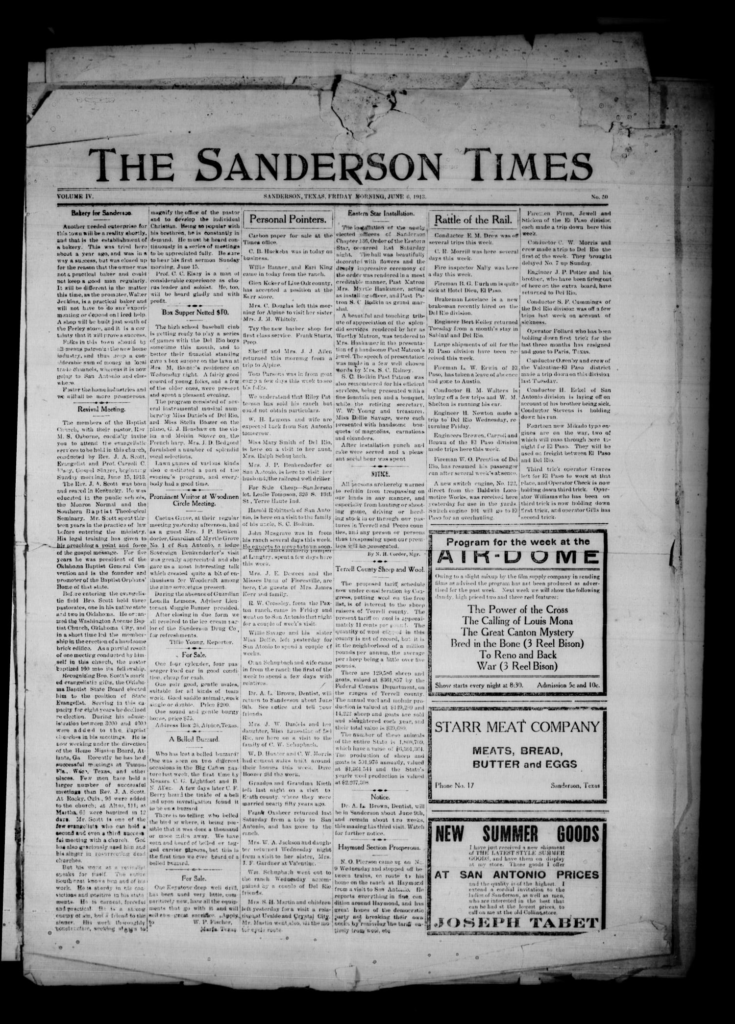
A Record of Local Newspapers
Sanderson’s local media history reaches back to at least 1903. The
Trans-Pecos News was published in Sanderson during the early years
of Terrell County, with surviving issues dating from October 1903 through
March 1906. A. T. Folsom is identified as editor in a 1906 issue, while
J. J. Allen was listed as business manager.
A few years later, The Sanderson Times was serving the community.
Surviving editions in the University of North Texas archive date from 1913
and 1914. Jesse McKee was documented as editor of the paper in 1913, and
Earle A. Reid was identified as publisher in 1914 issues.
Sanderson’s newspaper tradition continued into later generations. The
Sanderson Times reportedly ceased publication in 1998. The
Terrell County News-Leader was founded in late 1997 by Sheri
McDonald and Christine Hinkle, with its first issue delivered to Sanderson
homes on February 5, 1998. Hinkle later became sole publisher and editor,
and sold the paper to Jim Street in October 2002. Street continued
publishing the weekly newspaper until it closed in 2013. Later that year,
the Terrell County Sun began publication, with Allison Taylor
identified as editor at its launch.
These papers did more than fill space with headlines. They created a record
of the community: reporting local events, documenting public life,
preserving names and dates, and giving residents a dependable place to turn
for information.
Sanderson newspaper history
Newspaper
Documented period
Editor / publisher / operator identified
The Trans-Pecos News
At least October 10, 1903, to March 1, 1906. Surviving issues are
incomplete.
A. T. Folsom is identified as editor in a 1906 issue; J. J. Allen
was business manager. A local historical timeline also identifies
Henry Scudder Biggs as an earlier editor-publisher, but that claim
needs confirmation from a primary issue before being treated as
definitive.
The Sanderson Times
At least May 23, 1913, to August 8, 1914, in surviving archive
holdings.
Jesse McKee is explicitly cataloged by the University of North
Texas as editor for the June 6, 1913, issue. Earle A. Reid is
listed as publisher on 1914 issues; portal search metadata also
identifies Reid as editor, though the full record is less clearly
rendered.
Sanderson Times
Appears to have continued much later, reportedly closing
November 5, 1998.
Editor not established by the sources verified so far. A community
timeline gives the 1998 closing date, but it is not a formal
archive catalog.
Terrell County News-Leader
Founded in late 1997. First issue delivered February 5, 1998.
Published weekly until closing in 2013.
Founded by Sheri McDonald and Christine Hinkle. Hinkle later became
sole publisher and editor, serving until she sold the paper to Jim
Street in October 2002. Street then owned and published the paper
until its 2013 closure.
Terrell County Sun
First issue: November 2013.
Allison Taylor was editor at launch. The paper began publication
after the Terrell County News-Leader closed.
Research note: Early newspaper holdings are incomplete.
This table distinguishes documented archival information from details that
need additional primary-source confirmation. Information on the founding,
first issue, ownership, and editorship of the Terrell County
News-Leader was corrected using information provided by Christine
Hinkle, the paper’s co-founder and former publisher/editor.
From Print to Instant News
Today, information travels differently.
Many residents now learn about local events through Facebook, text messages, social media pages, private messages, phone calls, and conversations around town. Those tools can be helpful. They can get urgent information to people quickly, promote events, help neighbors locate lost animals, share a need, or alert the community to changing conditions.
The sheriff’s public social media account is one place where residents may see department related updates, public safety information, staffing announcements, and community posts as well as his political ambitions and endorsements. Terrell County also provides formal contact information for the Sheriff’s Office on it’s website at https://www.co.terrell.tx.us/page/terrell.sheriff.
Community Facebook groups serve a similar purpose. Sanderson Peeps describes itself as a place for Sanderson residents to share announcements, events, requests, tips, and community information.
But speed is not the same thing as reliability.
A newspaper article has a date, an author, sources, and an opportunity for facts to be checked. A Facebook post may be useful, but it may also leave readers unsure whether they are seeing an official county statement, personal opinion, political messaging, incomplete information, or a rumor already moving through town.
That is where a community can lose trust in it’s public entities.
When Official Information Becomes Rumor
One concern raised repeatedly by Sanderson residents is the belief that information connected to county offices sometimes reaches the public informally before there is an official notice, public record, or clear explanation.
Whether every story being repeated around town is accurate is not the point. The damage begins when residents believe private conversations, workplace knowledge from county employees, or unverified claims are being passed along with the appearance of official authority.
In a small town, that perception can spread quickly. A story may begin as a casual comment, move through social media or private conversation, and soon be repeated as fact before the people involved have an opportunity to respond. Details can be added, motives can be assigned, and a person’s reputation can be affected by something that was never formally confirmed.
Residents who have raised this issue describe a loss of trust. They worry about private matters becoming public discussion, information being exaggerated as it travels, and people feeling that they must be cautious about what they share around public offices.
The concern is not that people should stop talking to one another. Community conversation is part of Sanderson life. The concern is that public employees and elected officials hold positions of trust. Information connected to county government carries added weight because people naturally assume it is reliable.
That means there should be a clear line between official public information, personal social media commentary, workplace conversation, political messaging, and rumor.
Why Clear Boundaries Matter
Sanderson residents deserve prompt and useful information about public safety, emergency conditions, road closures, public meetings, scams, and other legitimate community concerns.
They also deserve to know when information is official and not political spin or personal vendetta.
County offices and elected officials can strengthen public trust by making sure important information comes through clearly identified public channels. Residents should not have to guess whether a statement reflects an official county position, a personal view, or something that has been passed along without confirmation.
A better standard would include:
- Official county information released through identified county channels.
- Clear separation between official duties and personal social media activity.
- Respect for the privacy of residents who are not public figures.
- Careful verification before public claims are repeated.
- A fair opportunity for people to respond when a public issue directly affects them.
- Public records, meeting minutes, and formal statements used when residents need confirmation.
Texas residents can request eligible government records under the Texas Public Information Act. That process gives the public a better path to reliable information than courthouse talk, private messages, or social media speculation.house.
What Local Media Can Do
Sanderson does not need less communication. It needs better information in the form of actual legitimate media not afraid to report facts regardless of pressure from individuals that seek to shape a narrative.
A strong local media culture does not exist to embarrass people, amplify personal conflicts, or turn private lives into entertainment. It exists to document local history, cover public institutions, ask fair questions, preserve the facts, and give residents a dependable record of what is happening in their community.
That is the value of Sanderson’s newspaper history. The Trans Pecos News, Sanderson Times, Terrell County News Leader, and Terrell County Sun all reflect a basic truth: small towns need their own voice.
That voice should be informed, responsible, and fair.
Before sharing a story about a neighbor, a county employee, a local investigation, or a public issue, it is worth asking a few questions:
- Is this confirmed, or is it simply something someone said?
- Did it come through an official public channel?
- Does the person involved have an opportunity to give their side?
- Would I repeat it if it involved me or my family?
- Is sharing it helping the community, or only adding to the noise?
In a town where information can travel quickly, the most valuable thing we can offer one another is not the fastest story.
It is the truest one.