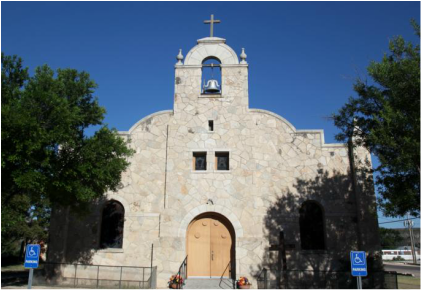
In a town’s history, churches help tell the story of what people chose to build and carry forward. In Sanderson, St. James Catholic Church is part of that continuing story, a place of Catholic worship with ties to an earlier adobe church and a congregation whose surviving records reach into the early twentieth century. Today, the Diocese of San Angelo lists St. James as a parish serving Sanderson.
For those interested in Sanderson’s history, the church offers a connection between the community’s past and its present: an older place of worship, a stone church that followed, and a parish that continues to celebrate Mass.
From an Adobe Church to Native Stone
A published photographic account of St. James describes an earlier Catholic church in Sanderson named Immaculate Conception. According to that account, parishioners built the adobe church on Oak Street before the congregation moved into the present building.
The same account dates construction of the current church to 1941 and identifies its building material as locally quarried native limestone. It also notes religious-themed slag-glass windows. These details offer an outline of the building’s history, although the construction date and the account of its predecessor come from a secondary source rather than a parish construction record.
The reported progression from a parishioner-built adobe church to a limestone building gives the story a distinctly local character. It connects the place of worship not only to the people who used it, but also to the materials of the surrounding country. The names of the builders, stoneworkers, and contributing families remain details worth recovering from parish records and family collections.
A Record of Catholic Life in Sanderson
One research guide lists St. James parish registers covering 1916 through 1956. That date range provides a starting point for exploring the congregation’s earlier history, but it should not be mistaken for a confirmed founding date.
The earlier church’s reported name, Immaculate Conception, also leaves an important historical question: when and under what circumstances did the congregation become known as St. James? The available account identifies the old and new churches but does not establish the circumstances of that change. A fuller parish history would help connect those chapters more precisely.
What can be said with confidence is that St. James belongs in the story of Sanderson’s religious life, both as a historic church building and as a parish recognized today by the Diocese of San Angelo.
A Parish Connected Across West Texas
St. James is part of the Diocese of San Angelo, whose official directory identifies it as a parish in Sanderson. Diocesan clergy-assignment notices also document shared pastoral leadership between St. James and Our Lady of Guadalupe Parish in Fort Stockton.
That connection remains visible on the Our Lady of Guadalupe parish website, which includes a page for St. James alongside its Fort Stockton churches. Sanderson’s Catholic community thus has its own place of worship while sharing a wider parish-service network.
Visiting St. James Catholic Church
St. James stands at Second and Hackberry streets in Sanderson. The Diocese of San Angelo lists its address as 209 E. Hackberry Street, while the parish website uses 409 N. Second Street.
The parish website lists Sunday Mass at 1 p.m., with confessions at 12:30 p.m. Wednesday services are listed as announced. Visitors should confirm the schedule before traveling, since service times can change. The listed parish contact number is 432-336-5027.
St. James is more than a historical subject to be viewed from the street. Its published worship schedule points to a church still fulfilling its central purpose: bringing people together for the sacraments and the practice of their faith. For visitors tracing Sanderson’s history, that continuing purpose is an essential part of understanding the building.