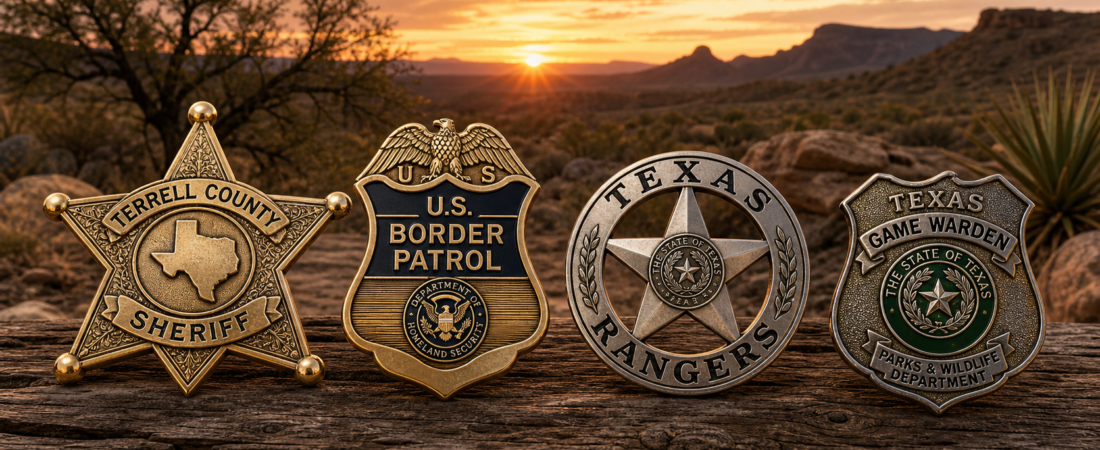
The Evolution of Law Enforcement in Terrell County
In a place as vast and sparsely populated as Terrell County, Texas, “law enforcement” has always meant more than badges and statutes—it has meant relationships, long miles, and a constant negotiation between frontier reality and the rule of law.
From early sheriffs and Texas Rangers riding into Sanderson to today’s layered mix of county officers, Border Patrol agents, and game wardens, the story of how peace is kept here is also the story of how the community itself has taken shape.
Terrell County Comes Into Being
Terrell County is a comparatively young county by Texas standards. It was formed by an act of the Texas Legislature on April 8, 1905, and officially organized a few months later on July 27 of that year.
Sanderson, already emerging as a railroad town along the Southern Pacific line, was chosen as the county seat and eventually became the main hub for government and justice in this remote corner of West Texas.
To understand law enforcement here, you have to start with the landscape. Terrell County sprawls across thousands of square miles of desert and canyon country, but has only a few hundred residents; as of the 2020 census, it counted about 760 people, making it one of the least populated counties in the state.
The distances between ranches and the harsh terrain have always made policing a fundamentally different job than in cities. The courthouse in Sanderson, the sheriff’s office, and later the Sanderson Border Patrol Station became islands of authority in a sea of open land.
In the early years, the county had to build up the basics: elect a sheriff, establish a jail, and create a local court system capable of handling everything from cattle disputes to criminal cases. When Sanderson became the county seat, it also became the place where disputes were formally resolved and where arrests ultimately ended up, no matter where in the county they originated.
Frontier Days: Rangers, Posses, and Early Sheriffs
Before Terrell County existed as a formal entity, law enforcement in this part of Texas was ad hoc, improvisational, and often personal. Texas Rangers, military patrols, and local posses handled many of the serious problems—cattle rustling, banditry, and conflicts over land and water.
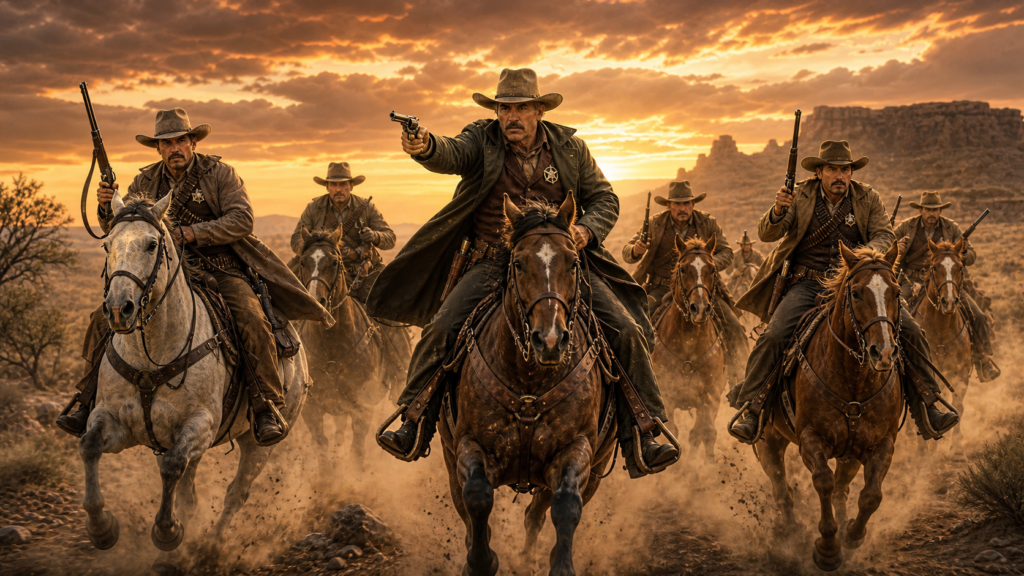
These forces weren’t permanently stationed in Sanderson, but they passed through, leaving a legacy of frontier justice and stories that would survive in family lore and local memory.
Once the county was created, elected sheriffs gradually took on more of the routine responsibility for maintaining the peace: serving warrants, mediating disputes, running the jail, and working alongside the local judiciary to give Terrell County something like a stable system of law.
In a county this size, the sheriff wasn’t just a law officer. He was a known figure—someone residents might see in the café, at the school, or on the highway heading out to a remote ranch.
The early sheriffs had to cover vast distances with minimal resources. A call for help might mean a long ride or drive over rough roads, often without backup and with limited communications. Much of their work revolved around property crimes, barroom disputes, and the occasional serious incident that required outside help—from Rangers, from neighboring counties, or from state authorities.
In a place where everyone knew everyone, maintaining the peace often depended as much on personal relationships and quiet conversations as on formal arrest powers.
County histories and genealogical sources suggest that many of these early sheriffs were ranchers or local businessmen who stepped into office, blending their knowledge of the land and people with the authority of the badge. They were the bridge between the old model of “the Ranger rides in when something big happens” and the emerging system of everyday, local law enforcement.
Railroads, Highways, and New Challenges
As the twentieth century moved forward, Sanderson’s identity as a railroad town and later as a highway waystation brought new law enforcement challenges. The Southern Pacific line carried workers, drifters, and travelers through town; U.S. 90 and other roads began funneling more traffic past the courthouse and sheriff’s office.
With more movement came more opportunities for crime—everything from theft and drunkenness to more serious offenses tied to smuggling and cross-border activity along the Rio Grande.
Sheriffs and deputies had to adapt. Instead of only dealing with long-time locals and ranch hands, they confronted people passing through who had no ties to the community. This changed the texture of the job.
Law enforcement in Terrell County now meant not only knowing the local families, but also watching the highways, the depot, and the motels, and coordinating with state troopers when incidents spilled over from the road into town.
At the same time, the vastness of the county and its proximity to remote border regions drew more attention from state and federal agencies. Rangers still came when things got serious, but gradually the presence of federal officers began to grow, setting the stage for a more permanent federal footprint that would fundamentally reshape law enforcement in and around Sanderson.
The Arrival and Growth of Border Patrol
The turning point came in the 1920s, when the U.S. Border Patrol as an institution was formalized and the need for permanent, professional border enforcement along the southern line became undeniable.
In 1924, the Sanderson Border Patrol Station opened, and it has been operating ever since. What began as a small outpost became one of the most enduring federal presences in the county.
Today, the Sanderson Station’s area of responsibility is enormous. It covers all of Terrell County, plus portions of Brewster and Pecos counties, encompassing around 3,000 square miles and 91 border miles between the United States and Mexico.
Agents based here patrol roads, ranch trails, canyons, and river corridors that most visitors will never see, working to detect and deter smuggling and unauthorized crossings, and conducting rescues when people become stranded or injured in the desert.
From the county’s perspective, the Border Patrol changed the landscape of law enforcement. The sheriff was no longer the only recognizable law officer. Green-stripe Border Patrol vehicles became a regular sight in town and on the roads.
Agents bought homes, shopped at local stores, and sent their kids to the school, blending federal law enforcement culture with the rhythms of small-town life.
Operationally, the relationship between the sheriff’s office and Border Patrol has evolved over time. County deputies and federal agents work different missions, but their paths cross frequently.
Smuggling cases and immigration investigations often involve county roads, ranch gates, and local resources. When someone is arrested, county facilities and courts may become involved, even if the underlying case is federal.
In emergencies—search and rescue missions, large incidents on U.S. 90, or multi-agency operations—the sheriff, Border Patrol, DPS, and sometimes Texas Rangers work side by side.
For residents, this multi-layered enforcement framework became normal. Seeing Border Patrol vehicles parked at the café or sheriff’s units passing through town feels as routine as watching trains or trucks roll by.
In a place where the border may feel far away on the map, federal presence has long been part of everyday life.
Modern Law Enforcement and Border Security Challenges
In the modern era, Terrell County law enforcement is best understood as a network. At the heart of it is the Terrell County Sheriff’s Office in Sanderson, responsible for patrolling the county, running the jail, serving civil process, and handling local criminal cases.
The current sheriff, Thaddeus C. Cleveland, brings a deep background in border enforcement, having spent over 26 years in the U.S. Border Patrol and eventually serving as Patrol Agent in Charge of the Sanderson Border Patrol Station before becoming sheriff.
Alongside the sheriff, the Sanderson Border Patrol Station continues its mission along the border and in the backcountry, focusing on smuggling, unauthorized crossings, and enforcement in remote terrain.
Texas Game Wardens also play a critical role; assigned to Terrell County, they are responsible for hunting and fishing enforcement, boat and water safety, and wildlife protection. In a county where recreation and ranching intersect, game wardens’ presence matters for both conservation and public safety.
Other agencies appear as needed. Texas Rangers still respond to major investigations when requested. The Texas Department of Public Safety handles highway enforcement and assists with larger criminal cases.
Federal agencies beyond Border Patrol—such as other branches of Customs and Border Protection or Operation Lone Star personnel—may be involved in cases that start in Terrell County but connect to larger networks.
For residents, this layered structure offers two realities at once. On one hand, there is a comforting sense that help is available: a sheriff’s deputy can respond to a local call, an agent can assist with a desert rescue, a warden can handle wildlife violations.
On the other hand, it means the county is always in touch with larger systems of state and federal authority. A local incident can become part of a statewide operation; a traffic stop on U.S. 90 can lead to federal charges; a rescue in a canyon can involve specialized teams and statewide news coverage.
Recent years have also brought intense border-security activity to the county. Sheriff Cleveland has testified that Terrell County does not have a traditional “crime problem” so much as a border security problem, citing steep increases in illegal alien arrests and smuggling activity compared to earlier years.
Joint operations with Border Patrol and Operation Lone Star have seized large numbers of vehicles tied to smuggling, and the rugged terrain has tragically contributed to a spike in deaths from exposure among migrants attempting to cross.
These realities color how residents think about law enforcement, the border, and what “security” should look like along the Terrell County stretch of the Rio Grande.
Politics, Controversy, and Border Infrastructure
In a small rural county, the sheriff’s role often extends beyond the badge into politics and national conversations. Sheriff Cleveland has become a visible figure in broader debates over border security and congressional representation in Texas’ 23rd District, which has drawn unusual attention to Sanderson and Terrell County.
Cleveland publicly considered challenging Congressman Tony Gonzales in TX-23 before deciding not to run and later supporting Gonzales, while sharply criticizing Republican challenger Brandon Herrera over comments and mailers he viewed as disrespectful to veterans and dismissive of suicide issues.
Those statements placed the Terrell County sheriff squarely in the middle of a high-profile GOP runoff and highlighted how local law enforcement voices can influence national races.
At the same time, Cleveland has taken positions that have surprised some observers. An outspoken critic of the Biden administration’s border policies, he has also publicly endorsed Democratic Representative James Talarico’s border-security plan, praising its focus on more agents and immigration judges rather than large-scale wall projects.
When Talarico visited Sanderson, Cleveland met with him and local residents to discuss a proposed 91-mile four-foot vehicle barrier through remote terrain, arguing that the Big Bend region already has “God-made barriers” and that spending billions on infrastructure where vehicles cannot practically cross is wasteful.
These moves have made him a controversial figure. Some conservatives view his praise of Talarico’s plan and opposition to certain border infrastructure proposals as “courting the left,” while others see it as a practical, terrain-driven stance rooted in his decades of experience patrolling the Terrell County stretch of the border.
Supporters argue that locally informed law enforcement voices should shape strategy, not just party platforms; critics worry that bipartisanship here might weaken the push for tougher physical barriers.
For Terrell County residents, the controversy plays out in a very personal way. The sheriff they call when something goes wrong is also the sheriff they see on television, in hearings, and in national articles about border security and infrastructure.
His positions influence how people inside and outside the county think about the trade-offs between barriers, boots on the ground, and the realities of rugged West Texas desert. In that sense, modern law enforcement in Sanderson isn’t just about enforcing the law—it’s about shaping the law and the policies that define how the border will be secured in the years ahead.
Shaping Community Identity
All of this—the early sheriffs and Rangers, the arrival of the railroad, the establishment of the Sanderson Border Patrol Station, the modern network of agencies, and the sheriff’s very public role in border politics—has shaped Terrell County’s identity in ways that go beyond official reports and statistics.
In a county this small, people know their officers. They see them at the school, the store, the football games, the café. The badge is worn by someone whose kids go to class with their own, whose truck is parked next to theirs at the grocery store.
Economically, law enforcement jobs are a significant part of local stability. The courthouse, the sheriff’s office, the Border Patrol station, and other government agencies bring steady employment, health benefits, and long-term careers to a place where private-sector opportunities can be limited.
Families who move here for these jobs buy homes, enroll their children in the Terrell County Independent School District, and become part of the community fabric.
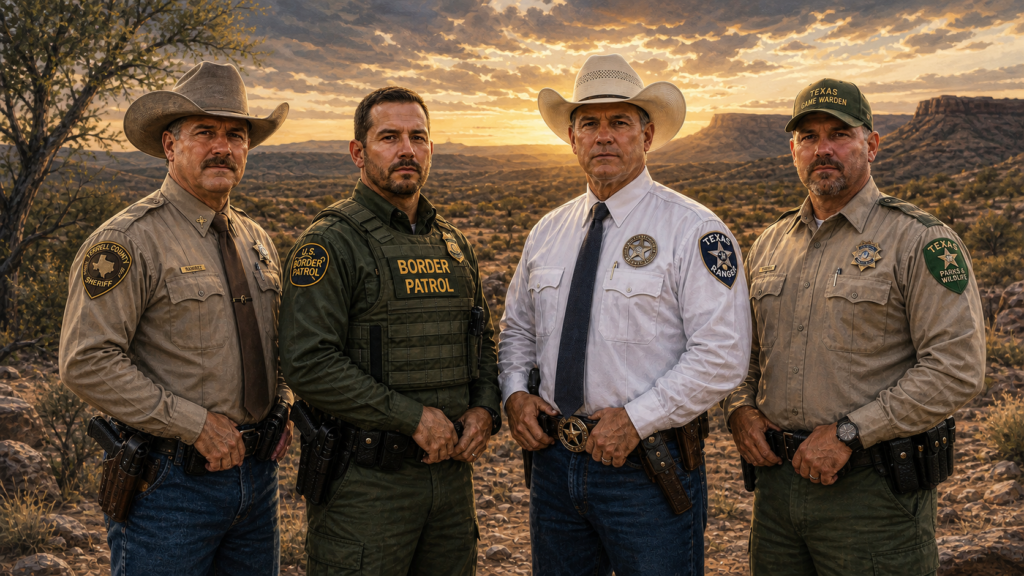
Socially, the presence of multiple agencies and uniforms gives Sanderson a particular look and feel. Visitors might be surprised to see federal vehicles in a town of a few hundred people, but locals take it for granted.
The idea that “help is a long way off” is softened by the fact that there are professionals trained to respond to emergencies—even if they still have to drive many miles to get there.
At the same time, law enforcement’s visibility can influence how the outside world perceives Terrell County. Media stories about big operations, rescues, or smuggling cases often mention the county’s isolation and the role of law officers in making the area safer.
For travelers heading to the Big Bend region or passing through Sanderson—the “Cactus Capital of Texas”—seeing both the sheriff’s unit and the Border Patrol vehicle can be a reminder that this is a working landscape, not just a scenic one.
In the end, the evolution of law enforcement in Terrell County is inseparable from the evolution of the county itself. What started as scattered Rangers and a lone sheriff riding rough country has grown into a layered, cooperative system of local, state, and federal officers all working different parts of the same puzzle.
As Sanderson continues to serve as county seat, visitor hub, and gateway to the borderlands and Big Bend, the men and women who wear the badge—whether county tan, Border Patrol green, or warden brown—remain central to how this small desert community lives, works, and welcomes the world.