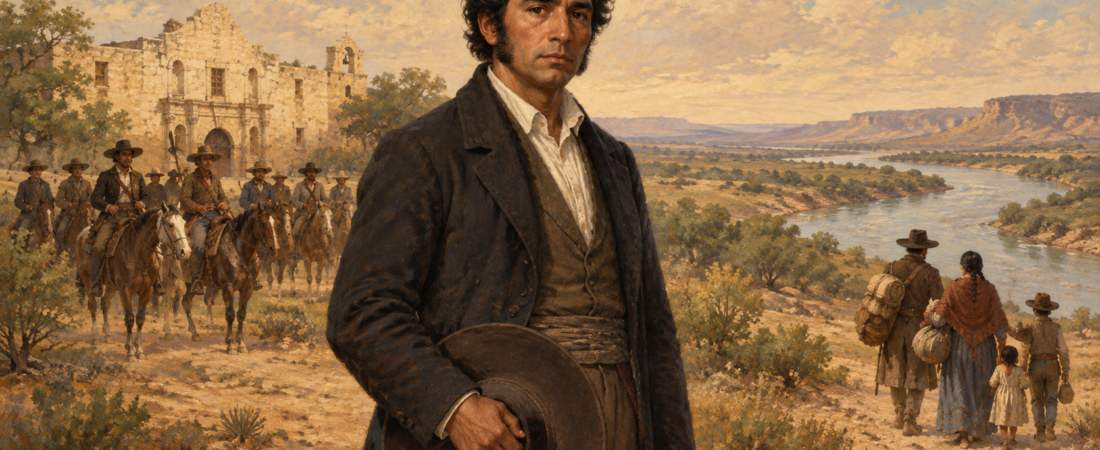
Texas history has a way of remembering a man’s battlefield service more clearly than what happened to him afterward. We put his name on a school, a street or a town, and sometimes forget to ask what his life was really like. Juan Seguín deserves a closer look.
Born in San Antonio on October 27, 1806, he helped win Texas independence, commanded Tejano soldiers at San Jacinto and served in the Senate of the Republic of Texas. He was also mayor of his hometown.
Yet in 1842, just six years after the revolution, he fled San Antonio in fear for his safety.
That is not a small footnote to an otherwise triumphant life. It is central to understanding the man and the Texas he helped create.
A Son of San Antonio
Juan Nepomuceno Seguín was born to Erasmo Seguín and María Josefa Becerra when San Antonio was still part of New Spain. His family was established in the community long before there was a Republic of Texas.
His father was a prominent public figure who encouraged Juan to read and write despite his limited formal schooling. As a teenager, Juan helped his mother operate his father’s post office while Erasmo served in Congress.
Public responsibility came early. Juan won election as a San Antonio alderman in December 1828. In 1833, at just 27, he was elected alcalde, the municipal office generally described as mayor. During much of the following year, he also served as acting political chief of the Department of Béxar.
Before anyone knew him as a revolutionary soldier, his neighbors knew him as a local official.
Seguín was a Tejano, a Texan of Mexican heritage. That matters because the Texas Revolution is too often told as though everyone fighting for independence had arrived from the United States. Seguín was fighting for the place where he had been born.
Why Seguín Joined the Texas Revolution
The struggle that became the Texas Revolution was more complicated than a contest between Anglos and Mexicans.
Mexico itself was divided over how the country should be governed. Federalists supported a system that preserved substantial authority for the states. Centralists wanted power concentrated in the national government.
Seguín supported the Federalist cause. In the spring of 1835, he led a militia company to Monclova to support the state governor.
After fighting broke out at Gonzales that October, Stephen F. Austin commissioned Seguín as a captain. He raised a company of 37 men who scouted, gathered supplies and helped carry out the December assault against Mexican general Martín Perfecto de Cos’s forces in San Antonio.
For Seguín and his men, this was not a distant campaign. The fighting had come into their own community.
Why Juan Seguín Left the Alamo
When Santa Anna’s army reached San Antonio in 1836, Seguín entered the Alamo with other members of the Texan force. He was later sent out as a courier, leaving before the final battle.
He did not survive the Alamo’s last stand inside the walls. He survived because he had been ordered out on military business.
After reaching Gonzales, Seguín organized another company and continued serving the revolutionary army. His men helped protect the retreat as Sam Houston moved east ahead of the Mexican army.
We tend to remember a retreat by the generals who ordered it. Behind those orders were frightened families, abandoned homes and people trying to carry what little they could manage. Protecting that movement was dangerous, necessary work.
His Tejano Soldiers at San Jacinto
Seguín commanded a Tejano company at the Battle of San Jacinto on April 21, 1836. The Texas State Historical Association identifies it as the only Tejano unit that fought in the battle.
Their service belongs in the main account of Texas independence, not tucked away as an interesting aside.
Following the victory, Seguín continued his military duties. He monitored the Mexican army’s withdrawal and accepted the Mexican surrender of San Antonio on June 4, 1836. He then served as the city’s military commander through the fall of 1837.
During that period, he also directed burial services for the remains of the Alamo dead.
Winning the war had not ended his responsibilities. There was a battered community to secure and the dead to honor.
A Senator Who Wanted Texans to Understand Their Laws
At the end of 1837, Seguín resigned his military commission after winning election to the Texas Senate. He served in the Republic’s Second, Third and Fourth Congresses and was the only Mexican Texan in that Senate.
Among his efforts was a push to have the republic’s laws printed in Spanish. He also chaired the Committee on Military Affairs despite his limited English.
Printing laws in Spanish was a practical matter. People needed to understand rules affecting their property, their obligations and their dealings with government. Spanish speaking residents were not strangers passing through. They were part of the population the new republic governed.
Seguín understood that winning independence was one task. Making a government serve the people who lived under it was another.
How San Antonio Became Unsafe for Its Own Mayor
Seguín left the Senate in 1840 to assist a Federalist campaign in Mexico. When he returned to San Antonio later that year, he found that he had been selected mayor. He was reelected at the end of 1841.
But the city had become increasingly divided.
Hostility between Anglo newcomers and Mexican Texans was growing. Seguín challenged Anglo squatters over city property. His land speculation, debts and business dealings also brought disputes and enemies.
He was not a man without faults or questionable decisions. An honest account does not require pretending otherwise.
In March 1842, Mexican general Rafael Vásquez occupied San Antonio. Seguín’s correspondence and connections with Mexico helped fuel accusations against him. Amid threats and growing suspicion, he feared for his safety.
He resigned as mayor on April 18 and soon fled to Mexico with his family.
Calling his departure a result of political unrest hardly tells the story. It leaves out the ethnic hostility, personal threats and property disputes that made remaining in his hometown dangerous.
His military service and years in public office had not protected him.
The Difficult Years in Mexico
Exile did not bring Seguín an easy refuge.
He entered the Mexican army, a decision he later said had been forced upon him. He participated in General Adrián Woll’s invasion of Texas in September 1842 and subsequently fought against United States forces during the war between the United States and Mexico.
That part of his life cannot be left out simply because it complicates the story.
Neither should it be presented without the circumstances that preceded it. Seguín had fled Texas fearing for his life, and his own account described his Mexican military service as coerced.
A fair reading requires holding both facts in view: he served in forces that fought against Texas and the United States, and he said he had been compelled to do so after being driven from his home.
His life offers little comfort to anyone looking for a simple tale with every loyalty neatly settled.
His Return to Texas
After the war, Seguín returned to Texas and settled near his father’s ranch in what is now Wilson County.
He gradually resumed public service. During the 1850s, he served as a Bexar County constable and an election precinct chairman. He later briefly served as Wilson County judge.
His exile was not one uninterrupted absence lasting until the 1860s. He came back, lived in Texas and again took part in its public affairs.
Late in the 1860s, he retired to Nuevo Laredo, Mexico, where his son Santiago had established himself. Nuevo Laredo is across the Rio Grande from Laredo, Texas. Seguín died there on August 27, 1890.
His remains were returned to Texas in 1974. On July 4, 1976, they were reinterred in Seguin, the city named in his honor.
Remembering the Whole Man
There is something painful about a man helping win a country’s independence and then finding himself unsafe in his own hometown.
There is also something worth respecting in his efforts to return and take up public service again.
Seguín’s record does not need polishing into perfection. His military accomplishments, political work, personal disputes and service in the Mexican army all belong to the same life.
We can honor his courage without overlooking his mistakes. We can examine his choices without excusing the hostility that drove him away.
To my mind, that is a more respectful way to remember someone than reducing him to a name on a sign.
Juan Seguín helped shape Texas. What Texas did with him afterward deserves to be remembered, too.