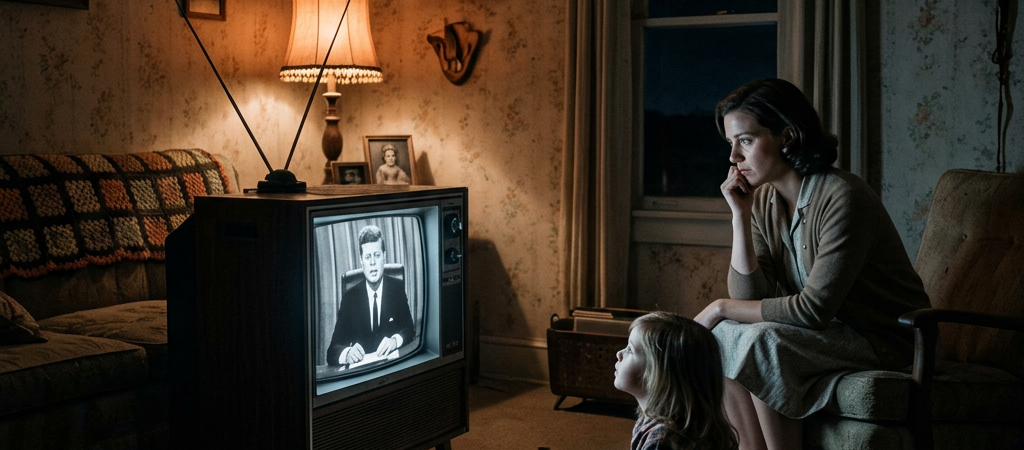
Sixty-four years have passed, but when I think about the Cuban Missile Crisis, I think first about being a little girl in West Texas and feeling afraid.
I could not have explained the difference between a Soviet missile and an American one. I did not understand diplomatic negotiations or military strategy. But children do not have to understand every word to recognize fear in the people around them. The possibility of war was frightening enough. The possibility of a war that could destroy entire cities was something else altogether.
Looking back, I cannot always separate what I understood then from what I learned afterward. But I remember the feeling: the world was in trouble, the grown-ups were worried, and something terrible might happen.
On October 14, 1962, an American U-2 reconnaissance aircraft photographed Soviet missile sites under construction in Cuba. Those images exposed a dangerous new reality: the Soviet Union was installing nuclear-capable missiles just off the American coast. Their discovery set in motion the confrontation that brought the United States and the Soviet Union closest to nuclear conflict.
There is an important distinction in this anniversary. October 14 was the day the photographs were taken. President John F. Kennedy was shown the evidence on October 16, beginning the period traditionally remembered as the crisis’s thirteen days. That period ended on October 28, when Soviet leader Nikita Khrushchev announced that the missiles would be withdrawn.
To a frightened child, those distinctions would have meant little. What mattered was whether we were going to be safe.
Today, with a lifetime behind me and much more understanding of what happened, I feel tremendous gratitude for President Kennedy. He faced choices that could have changed the future of every family in this country. What I admire most is his restraint—his willingness to stand firm without allowing the pressure for military action to close off every other possibility.
A Childhood Fear, Understood Across a Lifetime
Growing up in West Texas shaped the way I remember those days. This was home, familiar and far removed in my young mind from the places being discussed. Yet the fear did not feel far away.
That is what stays with me about the crisis. A child’s world can be small, but the worries of adults can enter it very quickly.
I would not pretend that my childhood memory is a complete historical record. It is not. The dates, the negotiations, and the military decisions became clearer to me later. What remained was the impression that something larger than anything I could understand was threatening the ordinary life I knew.
Now I understand how much was happening beyond our view—and how much even the people making the decisions did not know.
How the Missiles Reached Cuba
The confrontation did not arise in isolation. After the failed American-backed Bay of Pigs invasion, and while the Kennedy administration pursued further efforts against Fidel Castro’s government through Operation Mongoose, Cuba had reason to fear another invasion. In July 1962, Khrushchev and Castro reached a secret agreement to place Soviet nuclear missiles on the island to deter such an attack. Construction began that summer.
American intelligence detected a growing Soviet military presence, but the October 14 photographs supplied the crucial evidence of missile installations. Kennedy now faced an immediate problem: how to secure their removal without setting off a war with another nuclear power.
An attack might destroy some of the missiles. It might also provoke Soviet retaliation and leave Washington with little control over what happened next. Doing nothing would mean accepting a deployment Kennedy had publicly warned against. His advisers faced choices whose consequences could not be confidently predicted.
Understanding that history has deepened my respect for Kennedy. It would have been easy to mistake immediate military action for strength. He had to consider not only what an attack might accomplish, but what it might unleash.
My admiration does not require pretending that every decision his administration made was right. The history leading up to the crisis is more complicated than that. But at its most dangerous moment, I believe he showed the judgment the country needed.
Inside the White House: A Crisis Caught on Tape
Kennedy assembled a group of senior advisers that became known as the Executive Committee of the National Security Council, or ExComm. They considered air strikes, invasion, a naval blockade, and diplomacy. The Joint Chiefs of Staff favored an air strike followed by an invasion, while Kennedy ultimately chose a naval “quarantine.”
Those discussions left behind an unusually revealing historical record. Kennedy’s recording system captured key crisis meetings, allowing later generations to hear officials debating their options rather than relying entirely on memoirs written after the outcome was known. The National Archives preserves a recording of the October 16 deliberations, and the Kennedy Library makes recordings from the crisis available through its archives.
I find that remarkable. We can look back knowing the world survived. The people in those rooms had no such assurance.
They were weighing incomplete information, competing recommendations, and the possibility that an action intended to demonstrate resolve could trigger a response neither side wanted. Even the Navy’s procedures for signaling Soviet submarines with practice depth charges came before Kennedy and his advisers.
On October 22, Kennedy informed the American public in a televised address. He announced the quarantine and demanded the removal of the Soviet missiles. The administration deliberately used “quarantine” rather than “blockade,” seeking to distinguish its action from a measure associated with a state of war and to secure support from the Organization of American States.
The choice applied pressure while preserving time for negotiation. It did not remove the possibility that an encounter at sea could escape the control of leaders in Washington and Moscow.
This is one reason I praise Kennedy today. He did not simply choose between surrender and attack. He pursued a course that challenged the Soviet deployment while leaving room for an agreement.
Beneath the Surface: The Danger Aboard B-59
One of the most dangerous episodes occurred on October 27 aboard the Soviet submarine B-59. American naval forces were tracking the vessel and used practice depth charges as signals intended to bring it to the surface. What the Americans did not know was that B-59 carried a nuclear-armed torpedo. Each of the four Soviet submarines dispatched on that mission carried one.
The distinction between a signal and an attack was critically important—and dangerously difficult to interpret. Later Soviet accounts describe Captain Valentin Savitsky believing that his submarine was under attack and that war might already have begun. Some recollections report that he ordered preparations for the nuclear torpedo.
Vasili Arkhipov, the submarine brigade’s chief of staff, was aboard B-59 and helped prevent the situation from escalating. He is often described in popular accounts as simply the submarine’s second-in-command, but his position was a senior role within the larger submarine formation.
The familiar version of the story presents a straightforward confrontation in which Arkhipov alone refused permission to launch. The historical evidence is more complicated. Accounts differ about the precise sequence, and Arkhipov’s own later presentation did not explicitly describe his personal intervention. The National Security Archive’s research nevertheless supports his crucial role in calming Savitsky and helping avert a potentially catastrophic decision.
In one account collected by the Archive, Arkhipov recognized that American forces were signaling rather than attacking and called Savitsky back as the captain attempted to order an emergency dive and prepare the nuclear weapon. The order reportedly never reached the torpedo officer.
When I read about that encounter now, I think about how little we knew.
We were frightened by the danger we could see in the news. Beneath the ocean, there was another danger we could not see at all. American ships intended to communicate; a Soviet captain could interpret their actions as grounds for nuclear retaliation.
My gratitude belongs to Kennedy, but it also belongs to people such as Arkhipov. Whatever flag a man served under, helping prevent a nuclear catastrophe was a service to families everywhere.
The Deal the Public Did Not Fully See
October 27 also brought a new Soviet demand that American Jupiter missiles be removed from Turkey, along with the shooting down of an American U-2 over Cuba. As the pressure intensified, Kennedy continued searching for a diplomatic settlement.
The public agreement was straightforward: the Soviet Union would dismantle and remove its missiles from Cuba, and the United States would pledge not to invade the island. But a private understanding helped make that agreement possible.
On the evening of October 27, Attorney General Robert Kennedy met secretly with Soviet Ambassador Anatoly Dobrynin. He conveyed that the United States would remove its Jupiter missiles from Turkey, but that the withdrawal could not become part of the publicly announced settlement. Khrushchev announced his decision to remove the Cuban missiles the following morning.
The American missiles were withdrawn from Turkey in April 1963. The secret understanding remained concealed from the public for more than twenty-five years, complicating the popular picture of a confrontation resolved solely by American firmness. Pressure mattered, but so did compromise.
To me, that does not diminish Kennedy’s achievement. It makes his leadership more meaningful.
There are times when protecting the country matters more than appearing to win every point. I admire a president who could recognize that an agreement was worth pursuing even when part of the work had to remain private.
Nor did every element of the confrontation end on October 28. The naval quarantine remained in place while the United States sought the removal of Soviet IL-28 bombers, and it was lifted on November 20. The thirteen-day showdown had ended, but carrying out the settlement took longer.
A Hotline, Not a Red Telephone
The crisis revealed how difficult it was for the two governments to communicate quickly and understand one another’s intentions. Messages moved through formal diplomatic channels, intermediaries, and private meetings while military events threatened to outpace negotiations.
One practical response was the Washington–Moscow hotline. The agreement establishing the direct communications link was signed on June 20, 1963, explicitly addressing the danger that accident, miscalculation, or failed communication could trigger nuclear war.
Despite its familiar portrayal as a red telephone, the original hotline transmitted written messages through telegraph equipment. Its purpose was to give both governments a rapid, reliable means of communicating during emergencies—not to replace diplomacy, but to reduce the chance that confusion would become catastrophe.
The crisis did not end the Cold War or the nuclear arms race. It did give both powers an urgent reason to improve communication and pursue measures to reduce nuclear danger.
After something so frightening, even that practical step means a great deal to me. When the consequences are that grave, making it easier to speak—and harder to misunderstand—can be an act of protection.
What I Remember, and What I Understand Now
The photographs taken on October 14, 1962, began a chain of decisions whose consequences reached from the White House to the cramped spaces of a Soviet submarine. They also left a record that resists an easy story of victory and defeat: presidential deliberations preserved on tape, a submarine encounter reconstructed through later testimony, and a settlement whose private terms remained hidden for decades.
The little girl I was could not have understood all of that.
The woman I am today understands enough to be grateful.
I am grateful that President Kennedy did not confuse courage with rushing into war. I am grateful that he kept looking for a way out while insisting that the missiles leave Cuba. And I am grateful that, at crucial moments, people on both sides chose not to take the next irreversible step.
The enduring lesson is not that nuclear brinkmanship reliably works. It is that even carefully limited actions can become dangerous when an adversary misunderstands them—and that maintaining a path to agreement can matter as much as demonstrating military resolve. The Cuban Missile Crisis ended without nuclear war because pressure was accompanied by communication, compromise, and crucial moments of restraint.
Sixty-four years later, I still think about the fear of those days. But I also think about the life that followed.
For me, that is the most personal way to remember this history: not only as the October when the world came terribly close to disaster, but as the October when we were given the chance to keep growing up.