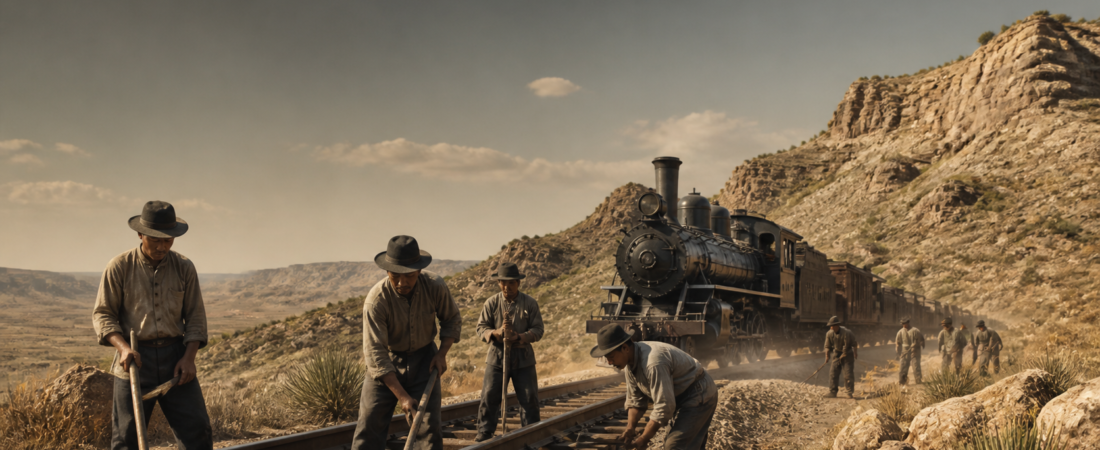
Part 3 of the Railroad Builders of Far West Texas series
Here in Sanderson, the railroad is more than a set of tracks running through town. It is part of the reason this community exists.
In the first two parts of this series, I explored the Chinese laborers who helped build the Southern Pacific route across far West Texas and the archaeological evidence from the 1882 construction camp near Langtry. That evidence gives us an important foundation: Chinese crews were part of the railroad-building workforce in this region, and their presence can still be traced through the remains of a temporary camp.
But archaeology and railroad records also lead to larger questions.
What did daily life look like for the Chinese workers who lived in those camps? What did they eat? How much were they paid? Were women and children present? How dangerous was the work? And what happened after the railroad was finished?
The complete answers are not always available for Langtry or Sanderson specifically. The public record does not yet identify individual Chinese workers at the Langtry camp, provide a payroll record for them, or establish a permanent Chinese community in Sanderson during the construction era.
Still, archaeological research at Langtry and historical research from Chinese railroad camps across the American West help us better understand the lives of the men who helped build the rail line that made Sanderson possible.
A workforce made up mostly of men
The railroad-construction workforce was overwhelmingly male.
Many Chinese laborers came from southern China, particularly Guangdong Province. They came to the United States for wages that could help support parents, wives, children, siblings, or future families. Some hoped to pay off debts. Some intended to return home after earning enough money. Others hoped to build a future in America.
Their individual stories were different, but many shared the reality of long-distance separation from family, uncertain employment, and discrimination in the country where they worked.
For the Langtry construction camp, the reviewed evidence does not establish that Chinese women or children lived there. The careful conclusion is that the camp appears to have been primarily a male railroad-construction camp. Like many railroad camps, it was temporary and organized around the immediate needs of construction: sleep, food, tools, supplies, and the next day’s work.
National immigration policy made family life even more difficult. The Page Act of 1875 severely restricted the immigration of many Chinese women. The Chinese Exclusion Act, signed into law in 1882, barred Chinese laborers from immigrating to the United States. These laws made it harder for Chinese workers already in America to reunite with family or establish permanent communities.
That history matters here. Chinese workers were helping build railroads that connected the country while federal law was increasingly restricting their ability to become part of it.
A temporary home on the rail line
At the Langtry Construction Camp, archaeologists found stone-lined tent platforms. These features provide direct evidence that workers lived in temporary housing at the site during railroad construction in 1882.
The camp was not a permanent town. It was a worksite built to support an intense construction push. Housing needed to be quick to set up, practical, and close enough to the work and supply system to support a large labor force.
Across the West, Chinese railroad workers lived in tents, rough bunkhouses, dugouts, shanties, and other temporary shelters depending on local conditions. The type of housing could change with the terrain, weather, availability of materials, distance from water, and how long the crew expected to remain in a location.
At Langtry, the camp’s location also reflects the difficulty of the terrain. The workers were building through a remote part of far West Texas, where access to water, supplies, and established communities could be limited.
Archaeologist Alton K. Briggs estimated that the Langtry camp may have held approximately 550 to 665 workers during its brief occupation. Based on the artifacts recovered, he estimated a Chinese-to-Anglo ratio of roughly 17 to 1. These figures are scholarly reconstructions rather than a census or payroll, but they strongly suggest that Chinese laborers made up the large majority of the camp population.
Food, cooking, and community
Some of the strongest evidence of Chinese daily life at Langtry comes from the camp’s cooking hearths.
Archaeologists found four double-hearth features at the site. Briggs interpreted them as traditional Chinese cooking arrangements, with one side used for steaming rice and the other for frying meat and vegetables.
That detail tells us a great deal.
Rice was a staple food for many Chinese workers. The ability to prepare it in a familiar way was practical, but it also helped workers preserve cultural routines in a temporary desert camp far from home.
Research from Chinese railroad camps elsewhere in the West shows that crews frequently relied on cooks, labor contractors, merchants, and supply networks. Their meals could include rice, tea, pork, poultry, vegetables, dried seafood, preserved fruit, and other goods that reached camps through Chinese merchant networks.
We should be careful not to claim that every food documented elsewhere was served at Langtry. The evidence at Langtry supports Chinese-style cooking of rice, meat, and vegetables. The broader evidence helps us understand the food traditions and supply systems that Chinese railroad crews commonly maintained across the West.
Food was more than fuel for physical labor. It was part of community, familiarity, and survival.
Long days and unequal pay
Railroad construction in the nineteenth-century West was physically demanding work. Crews graded land, dug cuts, moved rock and dirt, hauled fill, laid track, handled ties and rails, and worked in punishing weather.
Chinese workers often earned less than white workers, even when they performed similarly difficult labor.
On the Central Pacific Railroad, historical accounts show Chinese laborers receiving around $27 to $30 per month in the mid-1860s, while white workers were commonly paid about $35 per month and often received board. Chinese workers frequently had to pay for their own food and lodging from their wages.
That difference mattered.
A wage might appear only modestly lower on paper, but workers who had to pay for food, shelter, clothing, medicine, and other necessities had much less remaining to save or send home to relatives in China.
Historical accounts from the wider western railroad industry also describe Chinese workers receiving significantly less than white workers, sometimes earning only one-half to two-thirds as much.
We do not yet have a Langtry-specific payroll record that shows the exact wages paid to Chinese workers on this section of the Southern Pacific line. It would be inaccurate to assign a specific monthly amount to the men at Langtry.
However, the larger pattern is clear: railroad companies depended heavily on Chinese labor while often treating Chinese workers as a cheaper workforce.
The wages could still be meaningful when compared with the limited economic opportunities available to many workers in southern China. But work that offered wages was not necessarily work that offered equality, safety, or dignity.
Danger in far West Texas
Building a railroad across far West Texas required endurance.
The Southern Pacific’s western construction division was working toward the final connection near the Pecos River in early 1882. At the peak of that effort, the National Park Service reports that the western division employed more than 7,000 workers, including about 6,000 Chinese laborers.
That number reveals the scale and urgency of the project.
Workers faced heat, dust, difficult water supplies, long hours, remote living conditions, heavy tools, and the constant risks that came with moving earth, operating equipment, and laying rail. In mountainous parts of the West, Chinese railroad crews also faced blasting accidents, rockfalls, snowstorms, and avalanches.
The hazards in West Texas were different, but no less real. Desert heat, isolation, supply problems, and physically punishing work made railroad construction dangerous.
There is no reliable public total for deaths or injuries among Chinese workers on this particular Texas construction project. That gap in the record should be acknowledged honestly.
What can be said is that railroad construction was hard and dangerous work, and Chinese laborers carried a major share of it while facing discrimination and unequal treatment.
Organized workers, not anonymous labor
It is easy to picture railroad workers as an anonymous mass of labor. The historical record shows something more complicated.
Chinese railroad crews were often organized through work gangs, labor contractors, headmen, cooks, merchants, and community networks. Workers relied on one another for meals, housing, information, supplies, and contact with family and friends.
This organization helped Chinese workers endure difficult conditions and helped railroad companies complete enormous construction projects quickly.
Yet the workers’ importance did not protect them from racism.
Chinese laborers and Chinese communities throughout the American West faced discrimination, violence, exclusionary laws, and public hostility. They were often portrayed as outsiders even while their labor helped build railroads, towns, farms, mining districts, and commercial centers across the region.
The Chinese Exclusion Act became law in 1882—the same year Chinese workers were helping build the rail corridor through the Sanderson–Langtry region.
This is one of the central contradictions of the story: Chinese workers were essential to an expanding national transportation system, but the country increasingly used its laws to exclude them.
What happened after construction ended?
The Southern Pacific route was completed in 1883.
According to the National Park Service, most of the Chinese laborers who worked on the western division eventually returned to California after working on a branch line in the Mojave Desert. Only a small number remained in Texas.
That helps explain why the Chinese presence in this part of West Texas can be difficult to see in the historical record today.
The construction camps were temporary. The work moved west or east as each segment was completed. Many workers moved on to the next railroad project, returned to established Chinese communities in California, sought other jobs, or eventually attempted to return to China.
Records were often incomplete, lost, or never created. Local histories frequently focused on railroad executives, town founders, ranchers, and famous personalities rather than the laborers who did the difficult work.
But the workers’ contribution did not disappear because their names are hard to recover.
The Southern Pacific route helped create the conditions for Sanderson to grow as a railroad town. It moved people, mail, livestock, freight, supplies, and opportunity across a remote region of Texas.
Chinese laborers were part of the workforce that made that transportation route possible.
An unfinished local history
There is still much left to learn.
Future research may uncover railroad payrolls, company letters, historic newspaper articles, census records, archaeological reports, museum collections, photographs, or family documents that identify individual workers or reveal more direct connections to Sanderson.
A single payroll page, photograph, letter, artifact, or newspaper notice could add an important human detail to this history.
For now, the responsible approach is to be clear about what the evidence shows.
We can document Chinese railroad labor on the far West Texas construction corridor. We can document Chinese workers at the Langtry Construction Camp. We can see archaeological evidence of temporary housing and Chinese cooking practices. And we can use broader railroad history—clearly labeled as context—to better understand the difficult lives of the people who helped build the line.
The tracks that made Sanderson possible were built by many hands.
Some of those hands belonged to Chinese railroad workers whose names have not yet been recovered. Their lives were shaped by difficult labor, unequal treatment, family separation, cultural resilience, and a nation that depended on their work while often excluding them from its promises.
Their story belongs in the history of Sanderson, Langtry, and far West Texas.
Help document this history
Do you have historical photographs, family stories, newspaper clippings, letters, artifacts, or research related to Chinese railroad workers, the Southern Pacific route, Sanderson, Langtry, or the Pecos River corridor?
Please contact admin@sandersontexas.org or send a message through the SandersonTexas.org Facebook page. Sources and contributors will be credited when requested and when appropriate.
Continue the series
Railroad Builders of Far West Texas
A SandersonTexas.org History Series
- Part 1: The Chinese Railroad Workers Who Helped Make Sanderson Possible
- Part 2: The Lost Railroad Camp at Langtry: What Archaeology Reveals
- Part 3: Life on the Line: Food, Pay, Danger, and Family Among Chinese Railroad Workers
Sources and further reading
- National Park Service, “The Eastern/Western Divisions,” Amistad National Recreation Area.
- PBS, “Workers of the Central and Union Pacific Railroad.”
- National Park Service and related archaeological research on Chinese railroad-worker sites.
- Research on Chinese railroad labor, wages, discrimination, and the 1882 Chinese Exclusion Act.