
Part 2 of the “Railroad Builders of Far West Texas” series
A SandersonTexas.org History Series
In Part 1 of this series, Chinese Railroad Workers and Sanderson Texas Railroad History, I wrote about the Chinese railroad workers who helped build the Southern Pacific route through far West Texas—the railroad corridor that made Sanderson possible.
That history can feel distant when viewed only through railroad timetables, town histories, and old maps. But west of Sanderson, near Langtry, archaeologists found physical evidence that brings part of the story back into focus.
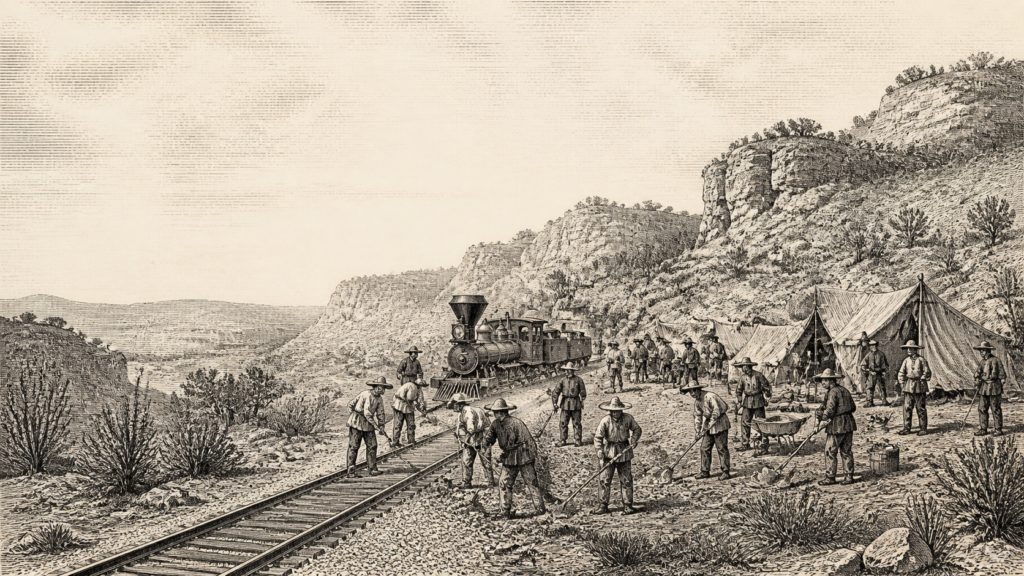
In 1882, as railroad crews pushed across the country toward the Pecos River, a temporary construction camp stood near Langtry. It was occupied only briefly, but the ground preserved clues about the people who lived and worked there: stone-lined places where tents once stood, hearths used for cooking, and artifacts connected to a workforce made up largely of Chinese laborers.
The site does not give us every answer. The available research does not identify the names of the workers, tell us where each man came from, or prove that Chinese railroad workers settled permanently in nearby towns such as Sanderson.
But it does establish something important.
Chinese laborers were not merely a distant part of Western railroad history. They lived and worked in this part of far West Texas during the difficult construction of the Southern Pacific line.
A construction camp near Langtry
The Langtry Construction Camp is identified in archaeological records as site 41VV585. Archaeologist Alton K. Briggs investigated the site in 1974, decades after the railroad crews had moved on. His work revealed evidence of a short-lived camp connected to the Southern Pacific construction drive of 1882.
This was not a permanent town. It was a mobile railroad camp, created to support the men doing the work as the line advanced eastward toward the Pecos River crossing.
The Southern Pacific’s western construction division was working from El Paso toward the Pecos River, under the direction of railroad superintendent James H. Strobridge. During the intense push of early 1882, the division reportedly employed more than 7,000 people, including approximately 6,000 Chinese laborers.[^1]
That larger workforce moved through a broad railroad corridor. The Langtry camp gives us one of the clearest physical windows into how part of that labor force lived in far West Texas.
What archaeologists found
The most revealing features at the Langtry camp were stone-lined tent platforms.
These were areas prepared to hold temporary canvas shelters. In a remote, dry, and rugged landscape, workers needed at least a basic place to sleep, store belongings, and recover after long days of railroad work. The tents themselves are gone, of course, but the stone arrangements remained.
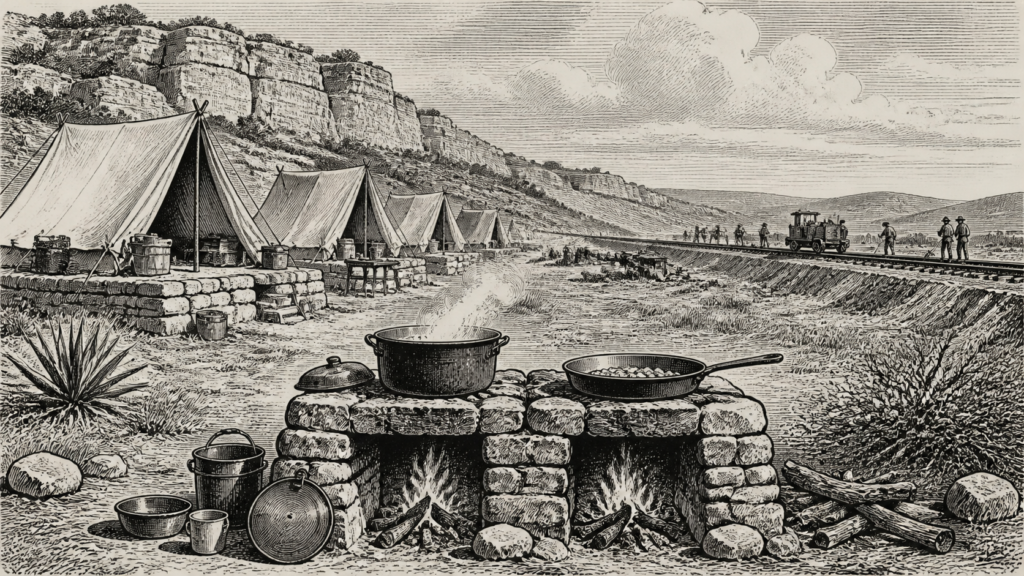
Archaeologists also documented four double-hearth features. Briggs interpreted these hearths as reflecting traditional Chinese cooking practices: one side could be used to steam rice, while the other could be used to fry meat and vegetables.
That detail matters because it turns an abstract number—“thousands of Chinese laborers”—into something more human.
It suggests workers were not simply passing through the landscape as anonymous labor. They were making meals, maintaining familiar routines where possible, and creating temporary living spaces in an unfamiliar and difficult environment.
At Langtry, archaeology does not just tell us that a railroad camp existed. It provides evidence of daily life within that camp.
A predominantly Chinese workforce
The artifacts found at the Langtry site led Briggs to estimate a Chinese-to-Anglo ratio of roughly 17 to 1. Later interpretations have described the camp as having a total population in the range of roughly 550 to 665 people, with perhaps 500 to 665 Chinese workers.
Those estimates should be treated carefully. They are archaeological reconstructions, not a surviving census, payroll list, or camp roster. They cannot tell us the name of any individual worker or the exact number of people present on a given day.
Still, the evidence strongly indicates that the Langtry camp was occupied by a predominantly Chinese workforce during the railroad’s 1882 construction push.[^1][^2]
This is especially significant for the history of Sanderson and Terrell County because it gives the region a documented connection to one of the least remembered workforces in the building of the American West.
The railroad that later supported Sanderson’s growth did not appear in the desert by accident. It was graded, supplied, repaired, and pushed forward by thousands of workers—including Chinese laborers whose contribution has often received too little attention.
Life at a temporary camp
It is easy today to travel the highway between Sanderson and Langtry and underestimate the isolation of this country in 1882.
There were no modern highways, air conditioning, convenience stores, cell phones, or quick access to medical care. The construction camps moved through country marked by distance, heat, wind, rough terrain, limited water, and long supply lines.
For railroad workers, the camp was both home and workplace.
Men likely began their days early and worked long hours on the tasks required to move a railroad forward: grading roadbed, moving rock and earth, preparing ties, laying track, handling supplies, and performing the countless supporting jobs needed by a large construction operation.
The exact job assignments of the workers at Langtry are not fully known from the surviving public record. It would be inaccurate to claim that every Chinese worker laid rails or performed the same kind of labor. Large railroad camps depended on many roles, including cooks, laborers, teamsters, water carriers, tool handlers, and camp-support workers.
What we can say is that the Langtry camp existed to serve a massive railroad-building effort, and Chinese laborers made up most of the people living there.
Their lives would have been temporary and demanding. The camp was not intended to become a community in the lasting sense. It was built around the needs of a construction project that moved on once the rail line advanced.
Food, routine, and cultural survival
The double-hearth features at Langtry offer one of the most meaningful clues from the site.
Food was more than fuel for hard labor. Cooking familiar foods could also preserve a sense of culture, routine, and dignity in a distant and unstable setting.
Research on Chinese railroad workers elsewhere in the West shows that rice, tea, dried foods, vegetables, pork, fish, and preserved ingredients were important parts of many workers’ diets when those foods could be obtained.[^2][^3] The Langtry hearths cannot tell us every meal that was prepared there, but they do show that Chinese cooking practices were present at the camp.
That is an important distinction.
We should not invent details that archaeology cannot prove. We do not have a Langtry menu, a Chinese worker’s diary from the camp, or a record of every supply wagon that arrived there.
But the hearths and other camp evidence allow us to say that Chinese workers maintained cooking traditions while living in this remote West Texas construction camp.
The ground has preserved a small but powerful reminder: these men brought knowledge, habits, and cultural practices with them. They were not interchangeable hands on a railroad gang. They were people making a temporary life far from home.
What we do not know
The Langtry camp is historically important partly because it gives us real evidence, but it also reminds us how much has been lost or left undocumented.
The public sources reviewed for this series do not identify individual Chinese workers who lived at the camp. They do not establish whether any women or children were present there. They do not provide a Langtry-specific payroll showing wages, work assignments, or names.
The broader railroad labor force was overwhelmingly male, and many Chinese workers in the American West were immigrants from southern China who had left families behind or hoped to support relatives through their earnings.[^2] But that broader historical context should not be treated as proof about any one person at Langtry.
The record also does not establish a permanent Chinese community in Sanderson during the construction era.
That does not weaken the story. It defines the story honestly.
We know that Chinese workers were a major part of the Southern Pacific construction force in far West Texas. We know that archaeology at Langtry documents a predominantly Chinese construction camp in 1882. And we know that the railroad corridor created by that labor made Sanderson’s development possible.
Those are substantial historical facts.
Why the Langtry camp matters
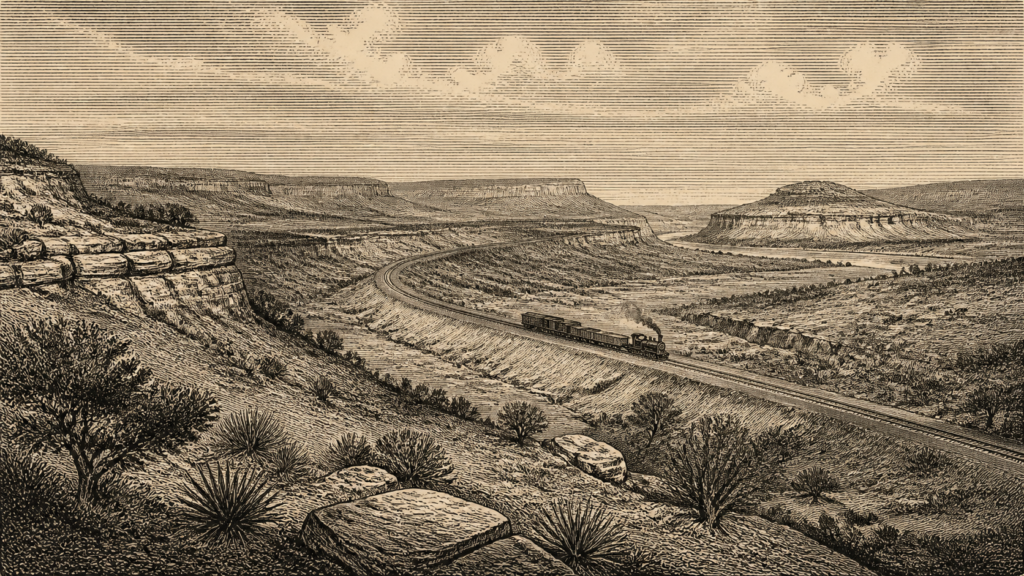
The Langtry Construction Camp deserves attention because it preserves a local connection to a larger national history.
Chinese railroad workers are often discussed in connection with California, Nevada, and the Central Pacific Railroad. Their work in Texas and along the Southern Pacific route is less widely known.
Yet far West Texas was part of that story.
The workers at Langtry lived in a harsh and temporary construction camp during one of the most ambitious railroad-building efforts in the Southwest. Their labor helped close a gap in a transportation system that would reshape trade, travel, settlement, and communication across the region.
For Sanderson, that railroad would become central to the town’s identity. It brought railroad employment, supplies, travelers, freight, ranching connections, and a reason for a community to grow in this remote part of Texas.
The archaeological site near Langtry helps us look beyond the finished railroad and ask a better question:
Who made it possible?
The answer includes thousands of Chinese laborers whose names may no longer appear in the local record, but whose presence can still be traced in the landscape of far West Texas.
Continue the series
- Part 1: The Chinese Railroad Workers Who Helped Make Sanderson Possible
- Part 2: The Lost Railroad Camp at Langtry: What Archaeology Reveals
- Part 3: Life on the Line: Food, Pay, Danger, and Family Among Chinese Railroad Workers
Help document this history
This research is ongoing.
Do you have family photographs, letters, newspaper clippings, railroad records, artifacts, oral histories, or research related to Chinese railroad workers, the Southern Pacific route, Langtry, Sanderson, or the Pecos River corridor?
SandersonTexas.org would like to hear from you. Historical leads will be researched carefully, and contributors will be credited when requested and appropriate.
The exact location of archaeological sites should be respected and protected. Please do not disturb, collect from, or publicize unprotected archaeological locations.
Next in the series: Life on the Line: Food, Pay, Danger, and Family Among Chinese Railroad Workers.
Sources
[^1]: National Park Service, “Railroad Divisions,” Amistad National Recreation Area.
[^2]: Barbara L. Voss, “The Experience of Labor: Chinese Railroad Workers in North America”, Stanford University Chinese Railroad Workers in North America Project.
[^3]: National Park Service, “Archeology of Chinese Laborers Connected a Country”.