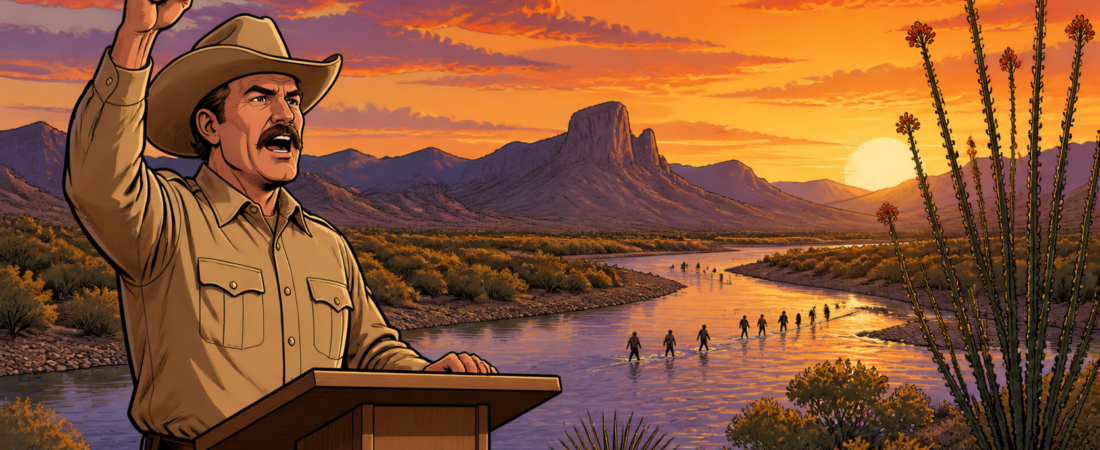
The debate over the Big Bend barrier project has become a contest between two incomplete slogans: “build the wall” and “save the park.” The public deserves a more honest discussion—one that recognizes local impacts while remembering that a remote international border is still a national-security responsibility.
Opinion analysis by SandersonTexas.org
Updated: August 11, 2026
A $1.7 billion project—and a misleadingly simple debate
A $1.72 billion federal contract labeled “Border Wall in Big Bend Texas” is now producing heavy equipment, road work, barriers, and surveillance infrastructure in the Big Bend region. That fact has prompted understandable concern among people who live, work, ranch, guide, and operate businesses in one of America’s most remarkable landscapes.
But it has also produced a debate in which the word wall is often used without enough precision.
The current public record does not show a plan to erect a 30-foot steel bollard wall inside Big Bend National Park. U.S. Customs and Border Protection has said its BBT-4 contract does not include a 30-foot barrier in Big Bend National Park, Big Bend Ranch State Park, or the Black Gap Wildlife Management Area. The contract instead includes approximately 17 miles of non-contiguous low-profile post-on-rail vehicle barriers and about 205 miles of detection technology, roads, and related system attributes. Construction is expected to extend into 2028.
That correction matters. Yet the opposite slogan—“there is no wall in the park”—can mislead too. Low-profile steel vehicle barriers, patrol-road work, utility improvements, cameras, sensors, and other border-security infrastructure are still physical construction. They still affect access, scenery, wildlife, drainage, and the daily experience of the places where they are built.
The larger regional plan is also more extensive than BBT-4 alone. CBP has publicly described about 175 miles of 30-foot bollard barrier across portions of Hudspeth, Jeff Davis, and Presidio counties, along with separate projects involving technology, roads, and vehicle barriers. The question is therefore not whether anything is happening. It plainly is. The question is whether the federal government should retreat from that effort because the project is unpopular in parts of the region.
This writer’s answer is no.
CBP should continue the Big Bend project because the security of the entire country should be the priority as it affects the entire country. That does not require an indiscriminate 30-foot wall across every canyon, park, ranch, or riverbank. It requires a disciplined security system: the least disruptive feasible alignment, surveillance and aerial capability, reliable agent access, targeted vehicle barriers, and physical barriers where the operational need is demonstrated.
A local border is still a national border
Big Bend is remote. That fact is at the center of the opposition argument. It should also be at the center of the national-security argument.
The Big Bend Sector covers roughly 517 miles of international boundary. Remote terrain does not erase the border; it makes observation, response, rescue, interdiction, and evidence collection harder. The Rio Grande, steep mountains, deep canyons, desert distances, and severe weather can hinder unlawful movement. They can also hinder the agents and local responders who must find a group, stop a smuggling vehicle, recover a lost migrant, investigate a criminal crossing, or reach an emergency.
The five Big Bend county sheriffs—Arvin West of Hudspeth County, Oscar Carrillo of Culberson County, Danny Dominguez of Presidio County, Ronny Dodson of Brewster County, and Thaddeus Cleveland of Terrell County—have jointly argued that a continuous physical wall is not the most practical or strategic response for this terrain. Their statement emphasizes natural barriers and favors targeted patrols, aerial systems, and sensors.
That is not a frivolous position. In fact, it identifies an important truth: border security is not one-size-fits-all.
But the same principle applies to the other side of the argument. A policy designed around what is least disruptive to a small number of local counties is not automatically the policy best suited to secure an international boundary. The federal government must account for national consequences, route displacement, future policy changes, smuggling adaptation, and the possibility that a presently quieter corridor becomes more active when enforcement pressure rises elsewhere.
No serious person can guarantee that today’s traffic pattern will persist. Routes shift. Smuggling organizations adapt. Migration incentives and federal policy change. And permanent infrastructure takes years to plan, fund, acquire land for, and build. Waiting until a corridor is already overwhelmed may be a politically comfortable approach, but it is not necessarily a prudent security strategy.
Barriers are tools—not magic, and not meaningless
The strongest version of the anti-project case is not that barriers never work. They do.
Government Accountability Office reporting has said Border Patrol views fencing as a tool that can slow illicit cross-border activity and give agents more time to respond. That is the central operational value of a barrier. A barrier can restrict vehicle movement, channel traffic toward monitored areas, increase the time needed to cross, and allow technology and agents to act.
A barrier is not magic. It cannot replace agents, air support, cameras, sensors, intelligence, roads, prosecutors, courts, detention capacity, or coherent federal policy. Nor does a barrier physically stop every person who wants to cross.
But the fact that a barrier is not sufficient by itself does not make it unnecessary. The right question is whether it contributes to a layered system in a particular location.
CBP’s own approach in Big Bend is not simply “wall everywhere.” It is a layered system: tall bollard barriers in some regional segments; low-profile post-on-rail vehicle barriers in selected locations; roughly 205 miles of detection technology around the BBT-4 component; road improvements; and surveillance systems. That design reflects the basic idea that different terrain calls for different tools.
A reasonable supporter of CBP can therefore oppose a 30-foot bollard wall through the most sensitive portions of Big Bend National Park while still supporting enforceable physical barriers, roads, sensors, and aerial surveillance where they are operationally justified. That is not a contradiction. It is what “smart wall” should mean if the phrase is to mean anything.
The sheriff question: a real tension, not a personal attack
Terrell County Sheriff Thaddeus Cleveland deserves close attention because he has one of the most consequential local voices in this debate.
In March 2025 congressional testimony, Cleveland described serious border-related challenges in Terrell County. He reported large increases in Sanderson Station apprehensions and estimated gotaways in fiscal years 2021 through 2023 compared with FY2020. He described human-smuggling activity, vehicle pursuits, damage to property, pressure on local emergency services, and migrant deaths.
But Cleveland also testified that activity in the most recent fiscal year had returned to historical trends, and he said additional state and federal resources had helped reduce the activity affecting his county. His policy conclusion was that much of the Big Bend does not need a broad border wall; he favored manpower, technology, and roads.
Those statements can be reconciled: a sheriff can recognize real illicit traffic and still believe that a tall continuous wall is the wrong response.
Still, there is a question that Cleveland and the other sheriffs should answer clearly. If technology, roads, and manpower are the preferred solution, what present staffing level, surveillance coverage, response-time standard, and interdiction rate would demonstrate that the strategy is sufficient? What specific increase in smuggling, gotaways, or vehicle incursions would show that a more substantial physical barrier is needed? And if agents need roads and surveillance systems, why should targeted vehicle barriers be ruled out before their operational value is evaluated?
Those are not hostile questions. They are accountability questions.
Local officials are right to demand that CBP explain its plans. CBP is equally entitled to ask local officials to explain how their preferred alternative will work through the next migration surge, the next policy reversal, or the next smuggling adaptation—not merely during a period of lower recorded apprehensions.
The cost is large locally, modest nationally
The $1.72 billion BBT-4 award is a very large number in a sparsely populated region. It should be scrutinized. Federal contractors should be monitored. Costs, change orders, land access, road impacts, and mitigation should be made public as fully as security permits.
But national-scale context matters.
The BBT-4 award is roughly 0.17 percent of an approximately $1.01 trillion FY2026 national-defense request. It is about 3.7 percent of the $46.55 billion identified in the FY2026 CBP budget framework for border infrastructure and wall-system funding. The project is expensive in everyday terms, but it is not enormous in the scale of national defense or border infrastructure.
The proper comparison is not between $1.72 billion and zero. The comparison is between the project and credible alternatives: more agents year after year, air operations, technology, road maintenance, emergency response, rescues, damage from smuggling, and the future cost of constructing infrastructure after a route has become active.
There is no public segment-by-segment analysis proving that every planned mile is the best possible expenditure. CBP should provide more detail. But the absence of perfect public proof is not proof that a permanent, layered system is wasteful. A country that spends hundreds of billions of dollars on defense cannot reasonably insist that every remote border-security investment wait until after a crisis is visible to everyone.
Rhetoric matters—and precision matters more
Opponents of the project have raised legitimate concerns about wildlife, drainage, visitor access, flood risk, cultural resources, private land, contractor conduct, and transparency. Some claims deserve investigation. The Texas General Land Office, for example, alleged that contractors cleared state-managed land in Presidio County without authorization. That allegation is a matter for evidence, process, and legal resolution; it should not be dismissed simply because the project is federally supported.
At the same time, the public discussion often collapses important distinctions.
Saying “a 30-foot wall is being built through Big Bend National Park” is not an accurate description of the current disclosed BBT-4 plan. Saying “there is no wall in the park” can also leave readers with the false impression that no physical border infrastructure is coming. Both versions obscure the actual issue: low-profile barriers, roads, technology, and construction activity have real consequences even when a tall bollard wall is not planned.
Claims that the project has “no purpose” are opinions, not established facts. CBP’s stated purpose is to restrict unlawful vehicle access, improve detection, and give agents access and response capability. People may disagree about whether that purpose justifies the construction. They should not pretend that no operational rationale exists.
Claims that specific infrastructure will certainly cause catastrophic flooding, irreparable ecological harm, or the destruction of tourism should likewise be identified as predictions or risk claims unless supported by project-specific engineering or environmental evidence. The federal waiver process has limited ordinary review, which makes independent scrutiny more important—not less. It does not make every prediction automatically proven.
Careless rhetoric also creates a practical concern for contractors and field personnel. There is no basis in the public material reviewed for this article to say that a particular Big Bend opponent has threatened workers or encouraged violence. That claim should not be made without evidence. But it is fair to say that describing people as illegitimate invaders, criminals, or destroyers—rather than contractors performing a government-awarded project—can encourage hostility toward individuals who do not set federal policy.
Criticize the project. Challenge DHS. Sue if there is a legal basis. Demand information. But do not dehumanize the workers or confuse allegations with settled facts.
What we know—and what we do not
What we know
- The Big Bend plan includes multiple projects, not a single uniform wall.
- CBP publicly describes about 175 miles of 30-foot bollard barrier in Hudspeth, Jeff Davis, and Presidio counties.
- BBT-4 publicly includes about 17 miles of low-profile, non-contiguous vehicle barriers and about 205 miles of technology and associated infrastructure.
- CBP has said BBT-4 does not include a 30-foot wall in Big Bend National Park, Big Bend Ranch State Park, or the Black Gap Wildlife Management Area.
- Construction activity and contractor mobilization have begun in the region.
- All five border-county sheriffs have opposed a continuous physical wall while favoring technology and targeted enforcement.
- National Border Patrol staffing has risen to a reported 21,471 agents, but CBP has not publicly provided a clear before-and-after staffing count for Sanderson Station or Big Bend Sector.
What we do not know
- The final alignment and design of every segment.
- The final all-in cost after change orders, land acquisition, maintenance, and litigation.
- The precise local staffing increase, if any, at Sanderson Station and Big Bend Sector.
- The full mitigation plan for sensitive locations, roads, drainage, wildlife, cultural resources, and public access.
- Whether the current project design will be changed again as maps, contracts, litigation, and access agreements evolve.
- Whether technology-and-manpower alternatives would produce equivalent or better security at a lower cost.
Uncertainty is not an argument for doing nothing. It is an argument for demanding better disclosure while the federal government continues to protect the border.
A practical path forward
The Big Bend should not be treated as expendable. Its parks, river country, ranches, roads, wildlife, cultural resources, and tourism economy are national assets too.
But the Big Bend should not be treated as a special exemption from the federal government’s obligation to secure an international border.
CBP should move forward, with five commitments:
- Use the least disruptive feasible alignment. Avoid a 30-foot bollard wall inside Big Bend National Park unless CBP can demonstrate that national-security necessity outweighs available alternatives.
- Retain a layered system. Use roads, sensors, cameras, aerial surveillance, agent access, targeted vehicle barriers, and physical barriers where the operational case is supported.
- Publish meaningful project information. Provide maps, timelines, public-safety procedures, mitigation plans, contract scope, and regular updates, subject to legitimate operational-security limits.
- Measure performance. Report, where possible, response times, vehicle incursions, detections, interdictions, rescues, maintenance costs, and the results of technology deployments.
- Protect people as well as land. Ensure contractors obey access requirements, respond promptly to verified damage claims, and protect workers, residents, visitors, and public servants from harassment or threats.
Readers who support this approach should contact CBP, the Department of Homeland Security, their U.S. representative, both U.S. senators, and Texas officials. Ask them to support the Big Bend security effort while requiring transparent design, responsible construction, real staffing data, and enforceable safeguards.
The choice is not between caring about Big Bend and caring about national security. The responsible choice is to do both.
Sources and Further Reading
Government and congressional sources
- CBP Smart Wall Map
- CBP Smart Wall Frequently Asked Questions
- CBP request for comment: Brewster County vehicle-barrier project
- DHS/CBP Big Bend border barrier system request for comment (PDF)
- Federal Register: February 2026 Big Bend Sector waiver determination
- Sheriff Thaddeus Cleveland’s March 2025 congressional testimony (PDF)
- Congressional Research Service: FY2026 DHS budget request
- GAO: Border fencing and performance measurement
- CBP: Border Patrol reaches 21,471 agents
Regional reporting and context
- Texas Public Radio: Construction start nears for Big Bend-area border wall
- Texas Public Radio: Where Big Bend wall plans stood in May 2026
- Big Bend Sentinel: Sheriffs unite against border wall
- Marfa Public Radio: West Texas sheriffs oppose Big Bend wall plans
- Texas Tribune: Big Bend barrier ban dies in House committee
- Texas Standard: CBP removes some projects from Smart Wall map
- Texas General Land Office: Texas border-wall construction status
Editorial note: Project maps, contracts, alignments, and public statements have changed repeatedly. Before publication, recheck each agency link and add the publication date of this article to the title and page metadata.