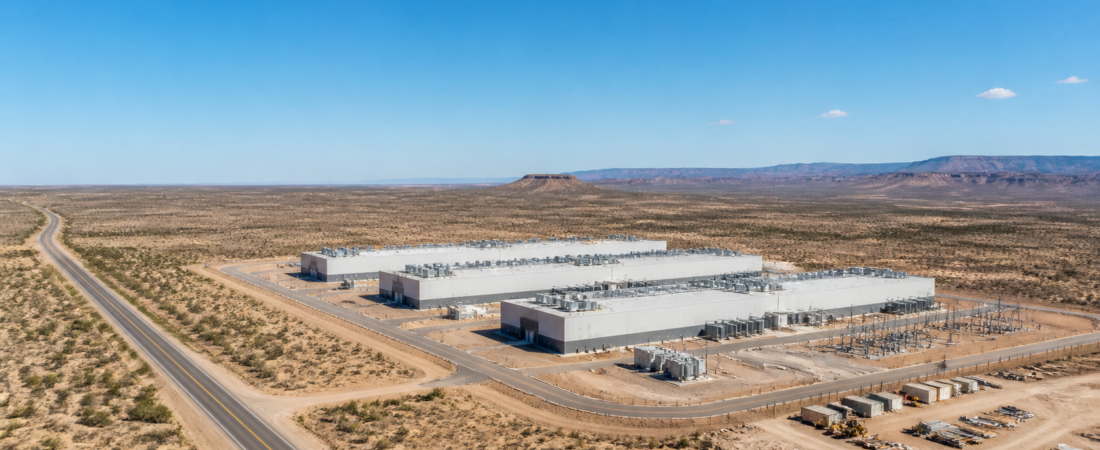
A proposed Amazon data center near Fort Stockton is one of the biggest industrial developments now being discussed in West Texas.
Texas construction filings list three proposed buildings at 6000 TX-18 in Pecos County under the name Pecos County Data Center. The filings identify Amazon Data Services, Inc. as owner. Each building is listed at 189,060 square feet and $300 million in construction cost, for a combined filed value of $900 million and more than 567,000 square feet of data-center space.
For Sanderson residents, the question is not whether a data center is going up inside town. It is not.
The question is whether a massive AI data-center campus and its supporting energy infrastructure in Pecos County could affect this part of West Texas over time.
The honest answer is simple: there is no evidence of an immediate direct impact on Sanderson—but there are real questions that deserve clear answers, public records, and continued attention.
Where is the Amazon data center?
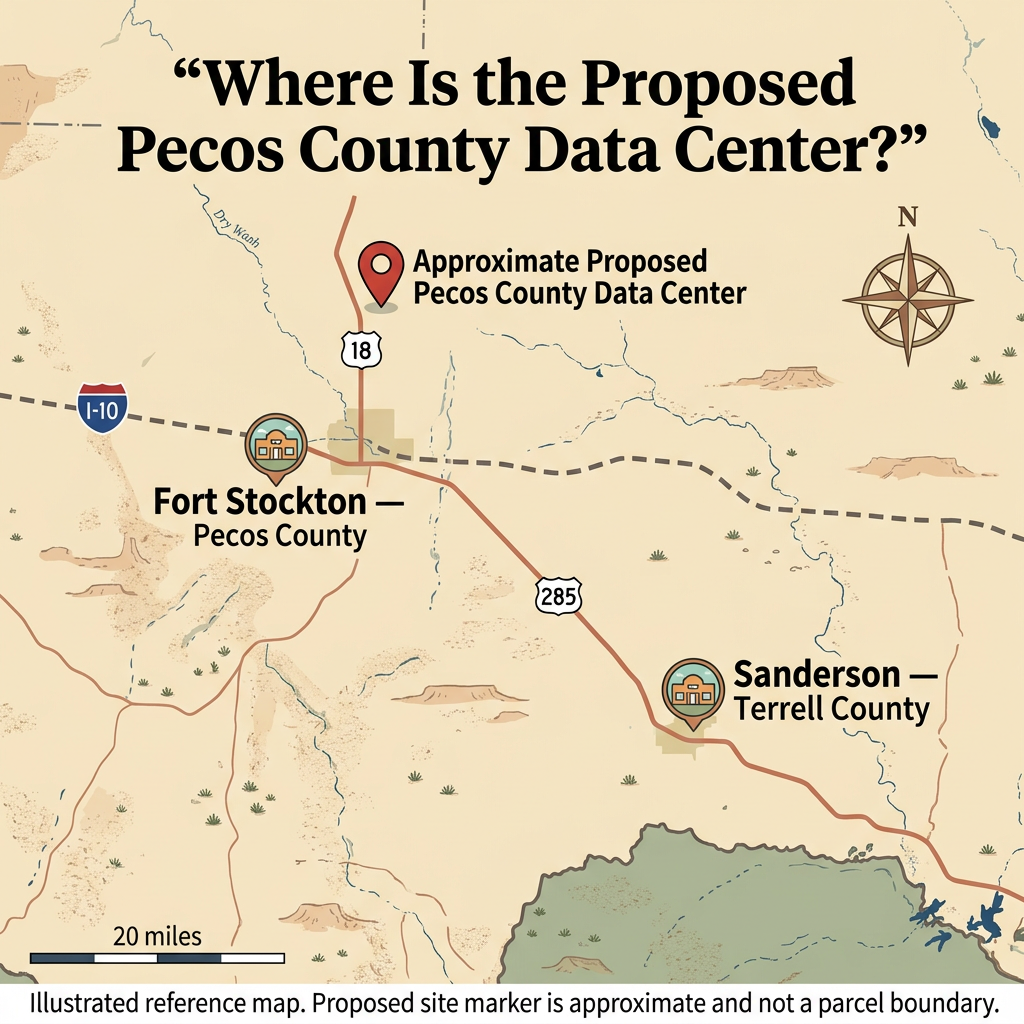
The proposed Pecos County Data Center is near Fort Stockton, not Sanderson. The Fort Stockton-to-Sanderson Highway 285 corridor is roughly 60 miles. That distance means Sanderson is not likely to face the project’s daily construction traffic, worksite noise, dust, road wear, or direct pressure on local emergency services.
Those impacts, if construction proceeds, will fall much more heavily on Pecos County, Fort Stockton-area roads, nearby landowners, and communities closest to the site.
That distinction matters. Readers should be cautious about claims that this project will immediately change life in Sanderson. Nothing currently public supports that claim.
But distance does not mean the project is irrelevant.
This is more than three buildings
The three data-center buildings are only part of the larger story.
Amazon has confirmed plans for a Pecos County data-center campus powered by new on-site generation. Reporting on the associated GW Ranch project describes a proposed 7.65-gigawatt natural-gas power plant with 35 turbines—an extraordinary scale for a private generation project.
Amazon says the planned campus would initially use new on-site generation rather than adding demand to the Texas electric grid, and that the project is designed to transition to grid-connected service as interconnection timelines allow. That is Amazon’s stated plan; the public should judge it by permits, construction records, operating data, and enforceable requirements—not by a press statement alone.
The company also says the project would use non-potable, brackish groundwater rather than drinking-quality or irrigation-quality water. Again, that may reduce one concern, but it does not end the conversation.
Water: ask for numbers, not assurances
Water is not a partisan issue in West Texas.
“Non-potable” means the water is not suitable for drinking or irrigation. It does not tell the public how much water will be pumped, where it will come from, how the aquifer will be monitored, how much will be lost through the cooling process, or what happens if water demand grows later.
Those are the questions that matter.
Sanderson is associated with the Edwards-Trinity aquifer system, while the proposed data-center campus is located in Pecos County. There is no current public evidence that the project will directly affect Sanderson’s water supply.
Still, a project of this size should make its water plan understandable to ordinary people. The public should be able to find the source, permitted volume, expected annual use, water-recycling design, and monitoring requirements without having to rely on rumors or social-media screenshots.
Power and air quality matter
The proposed generation is not simply a small backup-generator setup. The reported 7.65-gigawatt scale is why residents across West Texas are paying attention.
A project may be physically distant from Sanderson and still be relevant to the region through natural-gas supply, industrial development, air permits, and future infrastructure. State permits allow certain levels of emissions; they do not mean the public should stop asking how emissions will be controlled, monitored, and reported.
Sanderson residents should not assume they will experience direct local air-quality effects from a project near Fort Stockton. The available information does not establish that.
But they should expect transparent answers about the project’s fuel supply, emissions limits, monitoring, operating schedule, and any future transmission-line or pipeline proposals that could affect Terrell County.
Will this bring jobs and money?
A $900 million filing is a major number, but it is not the same thing as $900 million flowing into local households, local businesses, or public services.
The construction phase could create work for contractors, equipment suppliers, lodging businesses, restaurants, and skilled trades. But large data centers are capital-heavy facilities. Their permanent workforce is commonly much smaller than their construction footprint suggests.
Before celebrating or condemning the project, residents should ask:
- How many permanent jobs are projected, and what kinds of jobs are they?
- Will local and regional workers have a fair opportunity to compete for construction work?
- Are tax abatements, incentives, or infrastructure agreements involved?
- Who pays for road upgrades, emergency-response planning, water systems, and other public costs?
- What tax revenue would remain for local government entities after any incentives?
Those are not anti-business questions. They are the basic questions taxpayers should ask about any large industrial project.
What Sanderson should watch next
The Amazon data center near Fort Stockton is not currently a Sanderson emergency. It is, however, a West Texas development story worth tracking carefully.
The facts currently support neither panic nor blind reassurance.
The project exists in Texas filings. Amazon Data Services is listed as owner. The construction value is listed at $900 million. Amazon has publicly confirmed a planned Pecos County campus with on-site generation and has said it intends to use brackish groundwater.
What remains to be seen is how much water will be used, how the gas-powered generation will operate, what tax arrangements are made, how many permanent jobs are created, and whether future infrastructure reaches into neighboring counties.